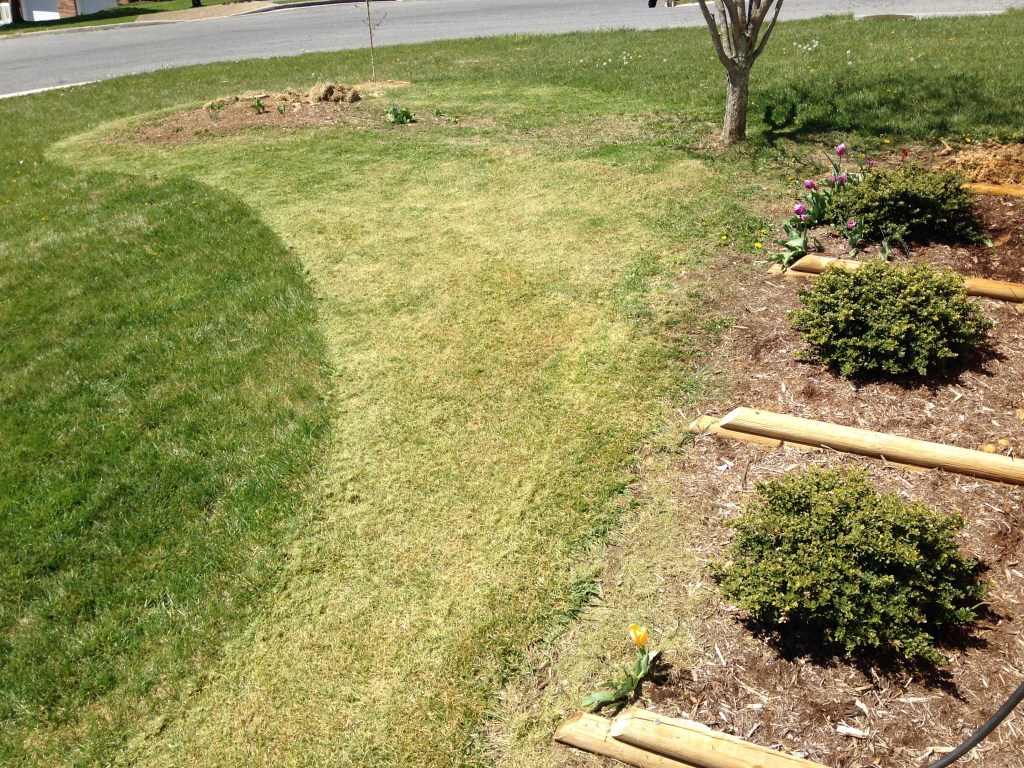
April 29: flower boxes

Bought:

  • 2 coconut liners at $3.99 each
  • 2 4-packs of purple pirouette petunias (grandiflora double) at $1.70 per 4-pack
  • 2 4-packs of white alyssum at $1.70 per 4-pack
  • 2 vinca majors at $1.75 each
  • 1 bag top soil at $3.99

Already had:

  • Potting soil
  • Oregano (or marjoram?) — dug up some that had spread

The coco liners were too tall for the containers, so I trimmed the liners until they were flush with the top edge of the metal basket. I lined each coco basket with the bottom of a white plastic tall kitchen garbage bag and cut snips for water to escape. 

I filled the plastic lined coco basket with a mixture of top soil and potting soil, then planted the plants. I watered in with two pitchers of fresh, cold water. It’s 90 today and sunny.

April 28: fertilized

I should have fertilized before putting the mulch down. That was a dumb mistake.

I dug in the fertilizer by troweling through the mulch, dumping fertilizer into the canal using a plastic cup, and covering the canal again with mulch on the following plants: 

  • Joe Pye weed
  • Rosemary under the stairs
  • Lilac and hydrangea by stairs
  • Milkweed
  • Echinacea in milkweed bed

My back was breaking by that point so for the remainder of the garden (and the remainder of the 18 lb bag of fertilizer, which was probably 3/4 full when I began), I dumped fertilizer on top of the mulch using a plastic cup:

Herb bed

  • Oregano and marjoram
  • Lavender 
  • Rosemary
  • Lemon thyme
  • Thyme
  • Wormwood

Mailbox

  • Indigo salvia

Front bed

  • Sedum
  • Indigo salvia
  • Vertical yew
  • Rue
  • Aster
  • Sedum
  • 2 coneflowers 
  • 3 blanket flowers
  • Yarrow
  • Hydrangea
  • Black eyed Susans
  • 1/2 of 2 hostas 

April 15: status of mulch, seedlings, and Joe Pye?

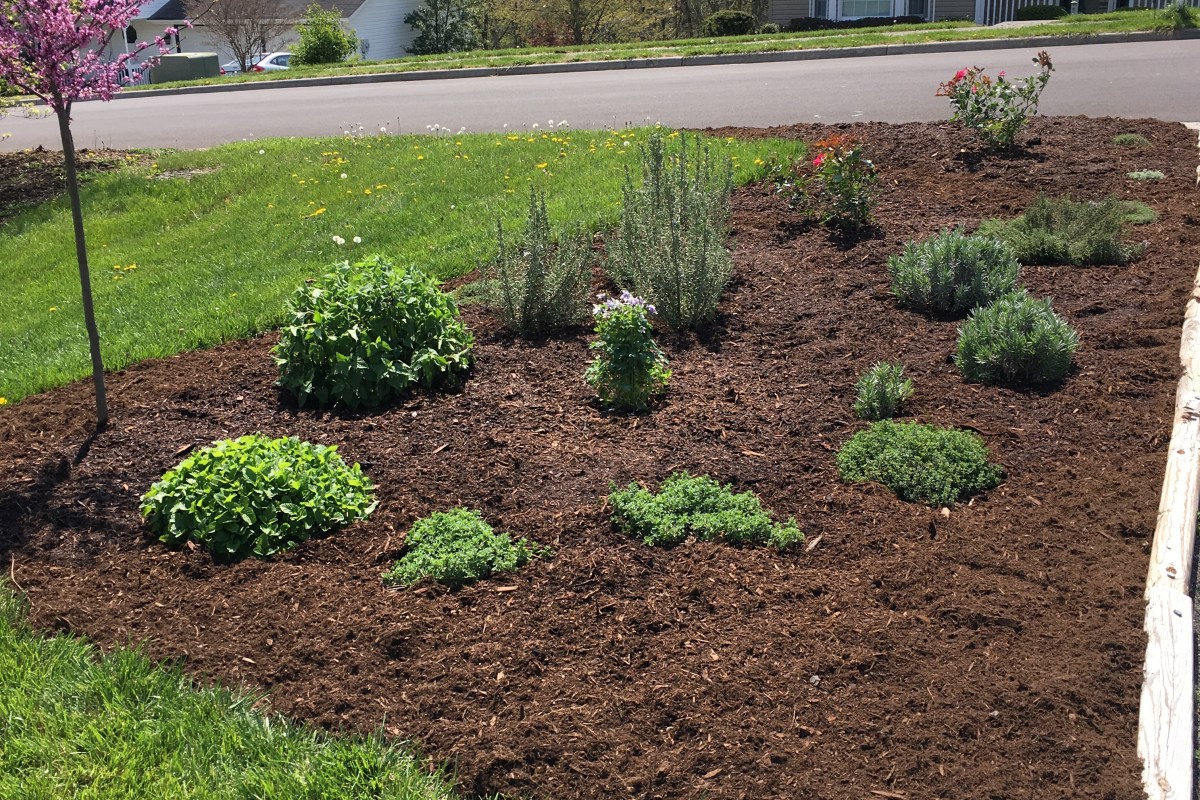
Moved bottlebrush from herb bed to wildflower hill
Swamp milkweed is emerging
Transplanted bee balm and mint for our front door pot
Some seedlings from wildflower mid are emerging by the mailbox
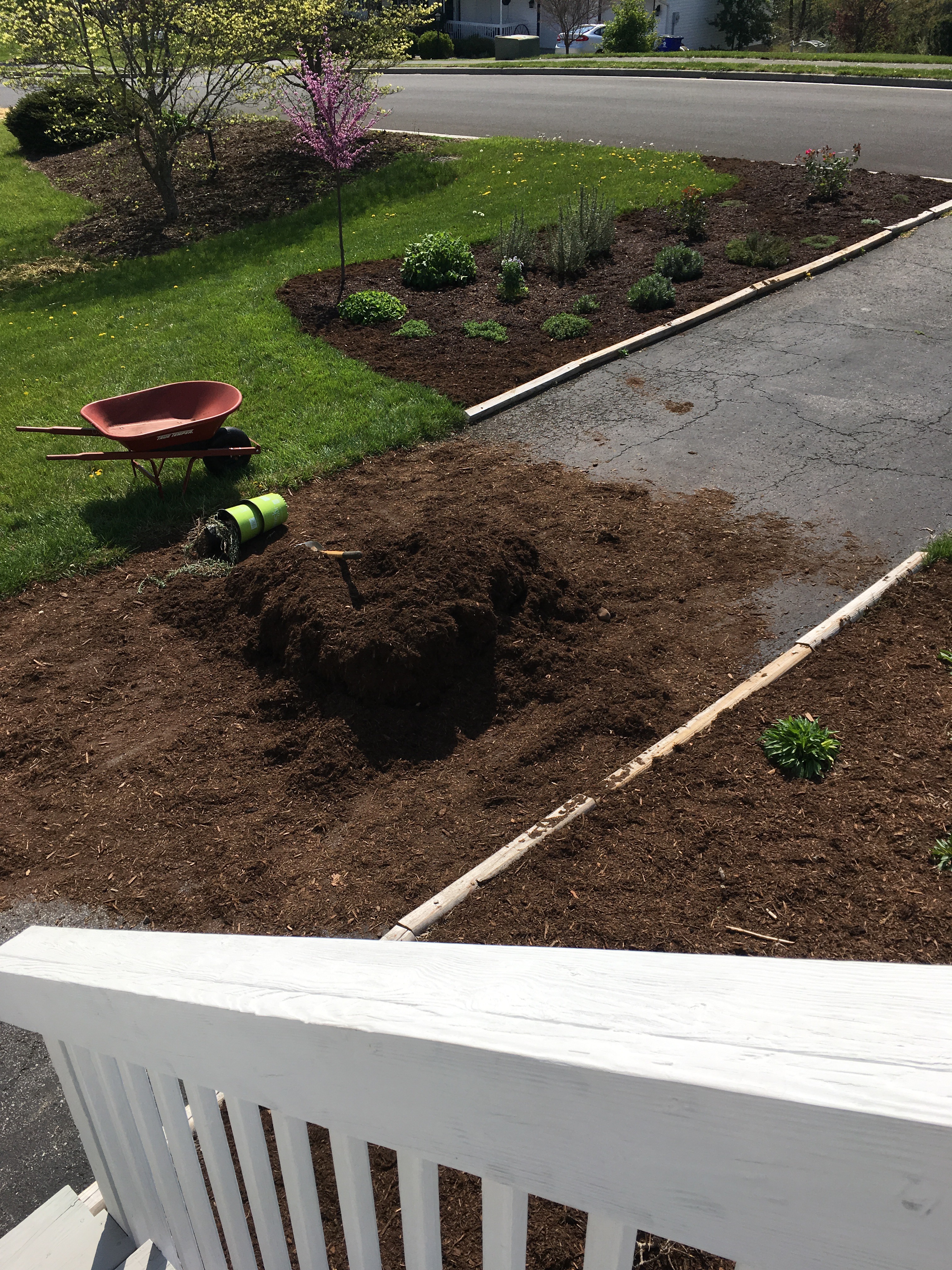
What’s left of 6 yds of mulch after mulching all the beds; need to do side of house and under stairs.
Echinacea volunteer, bottom left
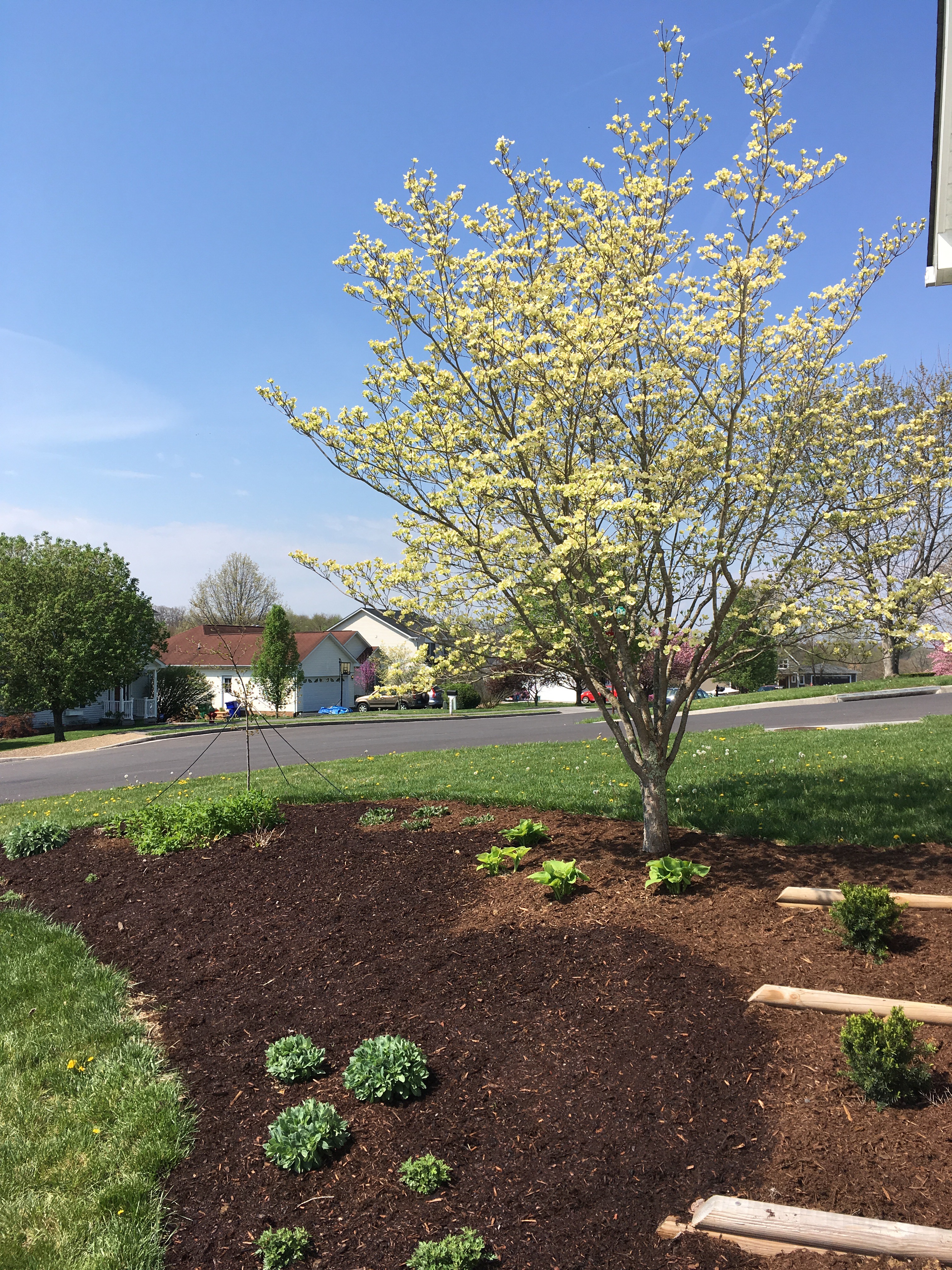
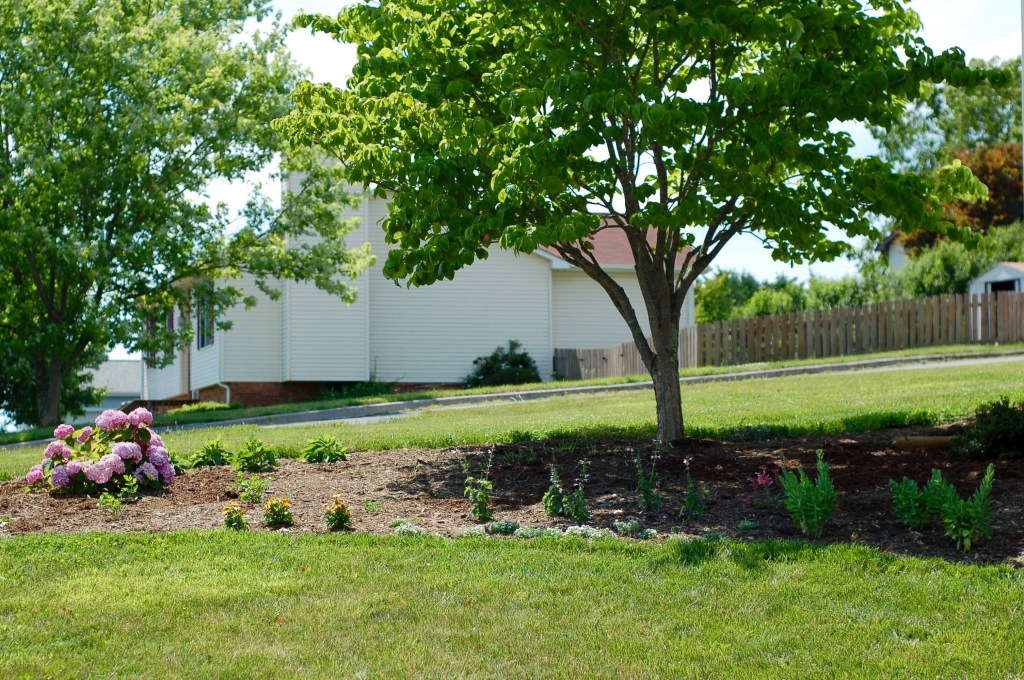
Dogwood and front bed, mulched
Planted roses and columbine today; mulched
Is this Joe Pye emerging?

Four sleeps until mulch

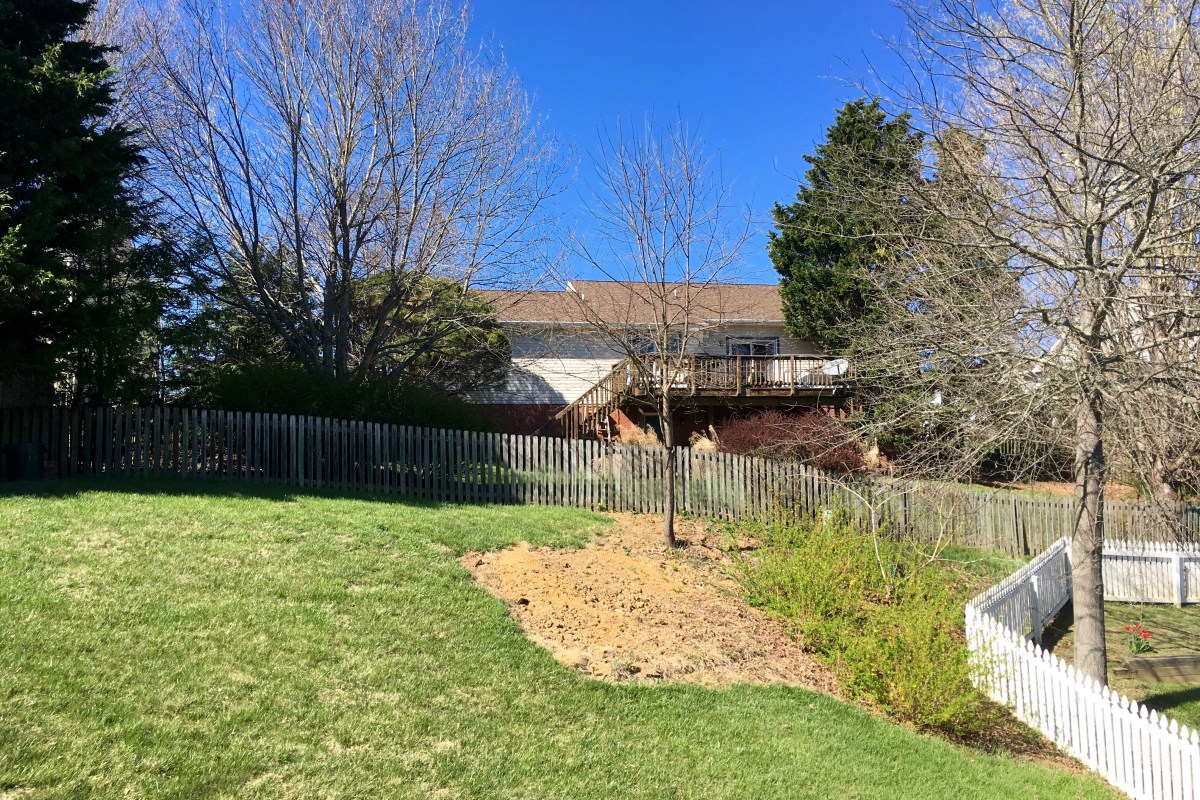
I am counting down the days until the mulch truck arrives. Three days, and then I can scatter wildflower seeds on the slope out back: a moment I’ve waited for for weeks.

I can’t stop thinking about the garden. Our back yard is a steep hill that makes me pant when I mow it. When we moved in, the top corner was overgrown with forsythia, brambles, poison ivy, and I don’t know what all else. Whatever was back there, it wasn’t pretty. It was a tangled, impenetrable mess I thought we’d never be able to clean up.

Slowly, over the past two years, we dug out stumps, pulled out vines, and eventually got the patch down to bare dirt. My husband and son got it to that point a few weeks ago, on a warm day in winter.

When confronted with a bare expanse of earth on our property, I want to fill it with flowers.

Since that day several weeks ago, I have consulted garden books, garden magazines, butterfly books, seed catalogs. I’ve been to our local nursery, Home Depot, Lowe’s, Pike nursery in Charlotte, NC, while we were there for our son’s soccer tournament. I’ve started a gardening notebook, an online gardening log, and added a Garden category to my blog menu so I can easily access posts that tell me when I did what in the garden in years past (we were <a href=”https://andreabadgley.blog/2016/04/18/building-a-flower-bed/”>killing lawn</a> this time last year).

I’m ready. And now the time is almost here. Three days until the mulch arrives. Three days until I can sow seeds.

We have a back deck I never sit on because there’s nothing to look at but grass. Instead, when I want to sit outside, I take a folding camp chair to the front garden and pop it open under the dogwood tree so I can be among hummingbirds and butterflies. Now, we have a bird feeder out back. It has lured goldfinches and woodpeckers to our back yard, so sitting out back is more appealing now. But there are still no flowers. Soon, though. Soon we will have a wildflower patch for butterflies and hummingbirds.

Starting Thursday, our kids’ spring break begins and so does mine. I’m taking several days off from work to play in the dirt. In my research I’ve found several species I *must* have out back for the butterflies — parsley, dill, cleome, zinnia, globe amaranth. I bought seed packets for those. I also have seeds gifted from my friend <a href=”https://birchnature.com/”>Dorothy</a>’s garden — milkweed, blazing star (Liatris), and blanket flower (Gaillardia). And to fill in the rest of the area, I bought a 1.5 pound bag of Pennington wildflower seeds to attract hummingbirds and butterflies. Surely from all of those sources, something will come up.

I’ve already got my first day off planned out. The day is forecast to be sunny, with a low of 41° F the night before, and a high of 71 during the day. I’ll have a lie-in, as my British friend calls it, to let the temperature come up a bit before heading outside. After my smoothie breakfast, I’ll pull a bowl from the cupboard and stir seeds from my store-bought packets and seeds from my friend into the wildflower mix from Pennington. I’ll huff up the hill with a hoe and a heavy rake to break up and smooth the soil, then I’ll sprinkle seeds over the entire area. I’ll rake again to cover them.

And when I hear the rumble of the mulch truck coming down the street, and the screech and clang of the metal dumper spilling 6 cubic yards of shredded hardwood bark onto our driveway, I’ll wheel my barrow down the hill and start shoveling.

The only thing I’m still trying to figure out is whether to distribute the seeds randomly, or to create a few patches within the plot — a milkweed clump, for example, or a dill clump. I still can’t decide.

I’ve got time. Three more days until the fun begins.

Rainy day at the book store

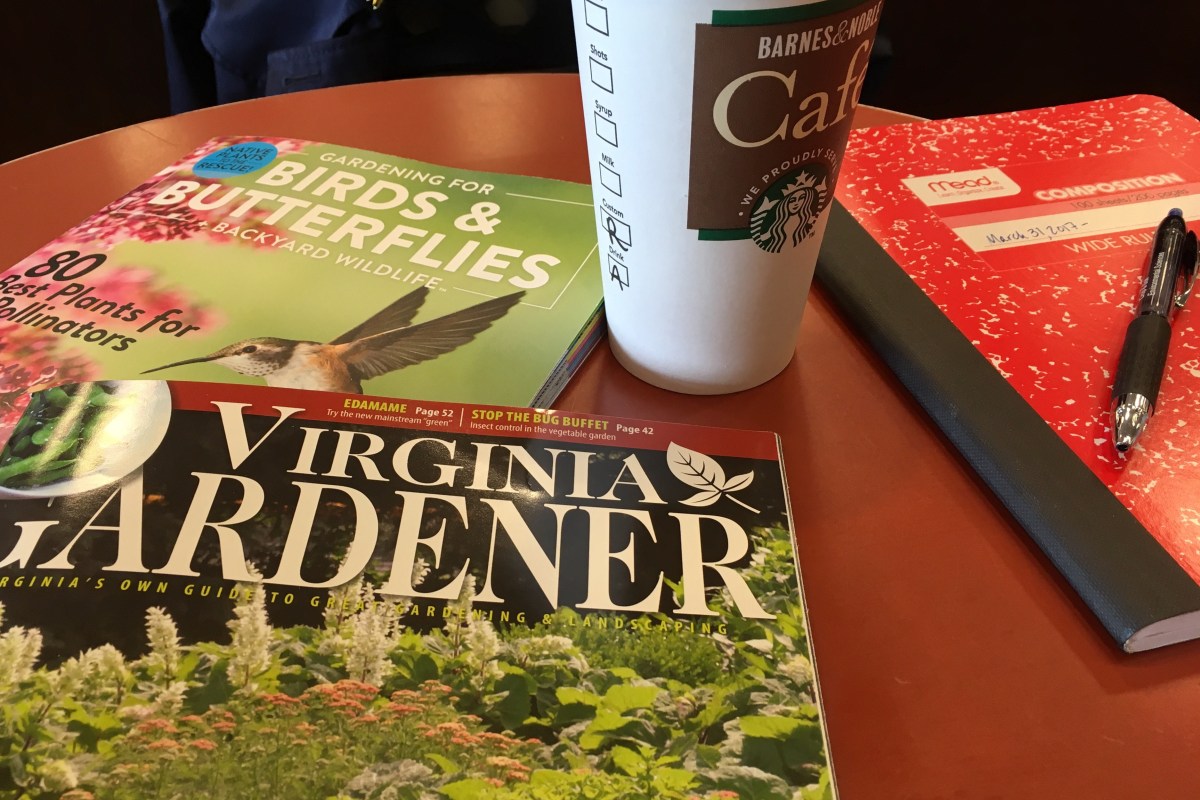
I am at Barnes & Noble on a sodden Friday — my flex day. On the round Formica café table are my coffee, two gardening magazines, and a warm peanut butter cup cookie on a white ceramic plate (“For here, please”). The café hums behind me — I spent far too much time selecting my seat (in the corner? by the window? with a wall behind me? facing the tables or the bookstore?) — and in front of me a man in a cobalt blue sweater and well-worn sneakers browses the technology aisle. Rain drops run in rivulets down the store windows, and I am cozy with my coffee, cookie, and composition book.

I left my laptop at home. In this murmuring book store, on my day off, I am surrounded by physical media. Journals, books, magazines. Vinyl, compact disks. My pen tip scratching across the blue-lined paper of a wide-ruled Mead composition book (they didn’t have college-ruled, which is probably for the best now that I have old-lady eyes).

Before I left home, I opened my computer to pay a bill and look up some phone numbers (eye doctor, nail salon) and hours (library, book store). As soon as I opened it, Slack boinged at me, Telegram dinged at me, red notification bubbles glared at me, and browser and calendar banner notifications slid open in the upper right of my screen. I quit every application quickly so I wouldn’t see anything that might suck me in.

I managed to not work — a narrow escape! — but did not manage to avoid falling into the digital chasm. After I finished my online errands, I somehow spent 15 minutes searching for desktop wallpaper to satiate my craving for turquoise water, warmth, and a feeling of tranquility. I have no idea how I ended up there. I did not find satisfactory wallpaper before realizing the trap I was falling into. I shut the laptop and left it behind so I could spend my rainy day flex day at the book store.

Cherry blossoms are popping pink against the brown landscape, and I saw my first tulip of the year today, a spring yellow. 

Today’s drenching should green the landscape quickly. I wanted to spend some time today weeding,  but I’m not sad the rain is keeping me in instead. I haven’t started thinking about the garden yet this year, and with how warm it’s been, I’m finally ready. On the table in front of me are a glossy, staple-bound Virginia Gardener and a matte, glue-bound Gardening for Birds & Butterflies

The green of their covers is fresh and alive compared to the dreary March grey outside. I fear I will leave here with a mind full of wishes, and a dangerous desire to spend a lot of money on flowers.

The garden is growing

Our grass-killing seems to have worked. After cutting the grass close to the ground, covering it with cardboard, then covering the cardboard with mulch to build up flower beds, we let them sit for a couple of weeks before planting.

On Mother’s Day weekend, we dug more than 150 holes, dropping perennials, annuals, and herbs into our newly formed beds. Now, the garden is growing. Most of the plants are still small, but echincea buds are plumping up, milkweed is blooming, basil is flourishing, and butterflies are finding us.

dogwood and plants
Dogwood bed

Soft shaping

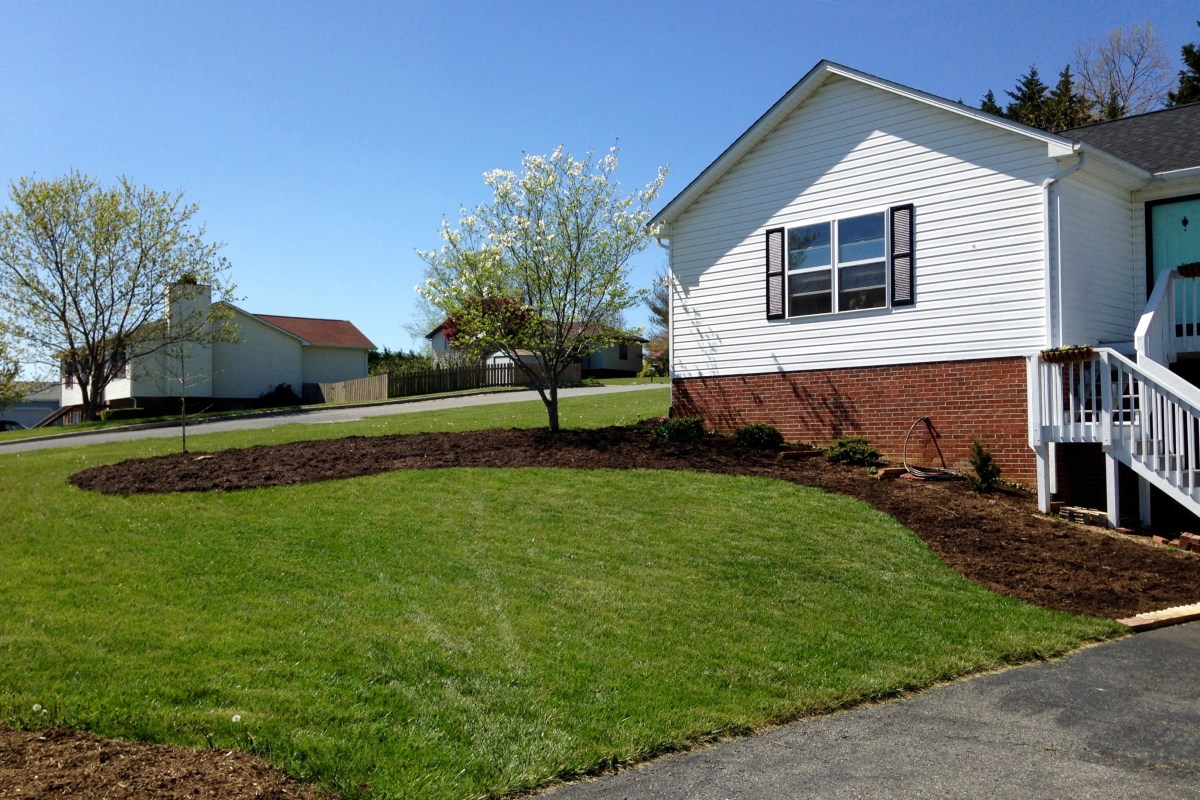
Curved flower bed

From the street, everything about our landscape was blocky. When we moved in, the front of our house was all straight lines and rectangles: driveway perpendicular to the street, stairs perpendicular to the driveway, flower beds parallel to the house. Right angles, hard lines.

When we lived in Maryland, we rented a small house that felt welcoming to every person who visited. A picket fence curved around the corner of the lot instead of meeting at right angles, and the path from the gate to the front door formed a graceful, elongated S. Nestled against the fence were the mounds of rounded flower beds.

On the inside, large floor-to-ceiling windows looked out on the gentle curves of the garden.  A raised brick hearth filled one corner of the living room: a foundation for the wood-burning stove. The pot-bellied stove and its hearthstone softened what would have otherwise been a sharp corner in the room.

All those curves made a difference. I am convinced they are what made the house feel so welcoming. They directed the eye, and the feet, to move along a pleasing path, without hard stops or starts. In our home now, I keep looking to see where we can add soft edges, where we can add graceful curves.

Out front, we can’t build an S walk to the front door since the door is on the second level, but we can add rounded flower beds. Already, with the first bed laid, the house feels more organic. The curved lines relax it.

In our living room, though, we have work to do. Rectangular windows, fireplace, bookshelves, rug; blocky, square furniture; hard slats of wooden blinds. We need some softeners in here. Circles, ovals, or something organic.

Looks like I have a new weekend project.

For the month of April, I will publish a 10-minute free write each day. Minimal editing. No story. Just thoughts spilling onto the page. This one is from the Daily Post one-word prompt, Curve

Flowering Dogwoods

Flowering dogwood, bright

“You know how you can spot a dogwood tree?” I ran my hand down the trunk of one at the Duke Gardens.

“By its bark,” I said. And then giggled. It’s dumb, I know, but it’s one of those things I remember from my ecology classes at the University of Georgia.

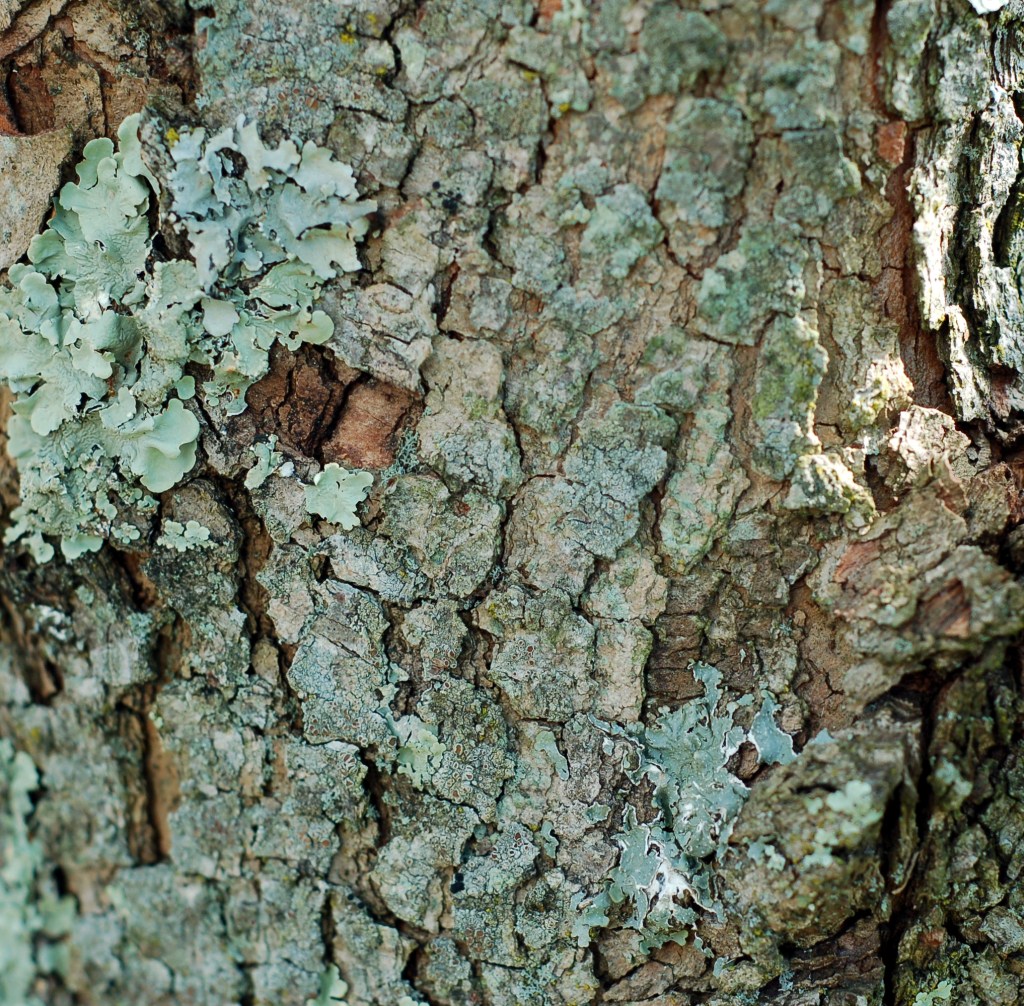
Dogwood bark and lichen
Dogwood bark

I can identify dogwood trees now, thanks to that joke, and ours is finally blooming. When the cherries, pears, and redbuds were blossoming, I couldn’t figure out why our dogwood wasn’t full of flowers too. Shouldn’t it come early with the other blooming trees?

In my home state of Georgia, I remember dogwoods being my favorite part of spring. They were the only flowering tree I knew, and when I was in college in Athens, where trees stripped bare in winter, dogwoods flowered before  any green reappeared in the woods. I’d drive the three and a half hours from the foothills of the Appalachians to my home on the Georgia coast, and all through the forest, in the otherwise brown understory, I would see small trees dotted with white blossoms. Dogwoods.
I photographed our dogwood here in Virginia during the time of the cherry, pear, and redbud blooms. The dogwood flowers were small and green.

early April dogwood flower
Dogwood flower, April 2

I thought they’d be peaking the same time as the other flowering trees, so I wondered, Do we have a different kind of dogwood? I had never watched a dogwood flower up close before, so I didn’t know if that was all they’d do, or if the flowers would grow.

Flowering dogwood, bright
White dogwood flower, April 23

The flowers grew. They took their time. Over a period of three weeks, they slowly spread their celadon petals, and they deepened to a rich white.

Maybe I’m remembering wrong about the earliness of dogwoods in Georgia. Maybe they seemed first because they were only. Either way, I love that we have one in our garden. I’m sitting with it now, in fact.

Birds trill, a breeze moves the branches, white clouds drift in a blue sky, and we have a flowering dogwood tree.


Building a flower bed (Killing Grass: Round 2)

My skin is pink and warm. I spent all weekend outdoors, in the garden and on the soccer pitch.

The fresh air, dirt, and blue-sky matches were totally worth the sunburn.

Our neighbor has a farm truck and told us these past weeks that he would soon fill it with a (literal) ton of mulch; he wouldn’t need it all, and would we like to split a truck load with him? He dumped the mulch Wednesday, and on Saturday, our daughter and I drove around town collecting cardboard and newspaper: we were going in for round two of killing the lawn so we can put in a flower bed.

Our first attempt at killing grass with garbage bags failed, so we pivoted. We did some research, and I think we have a better chance of succeeding this time with compostable materials that worms can eat instead of ugly black plastic.

In preparation, my husband lowered the mower blade as low as it would go, and cut a curved shape in the lawn where the flower and herb beds would soon go.

shorn grass for flower bed
Shorn grass for the front flower bed.

Our daughter has been as eager to get out in the garden as I am, and she helped me cover the soon-to-be-dead grass with cardboard and newspaper.

watering cardboard 17
Laying cardboard over close-cut grass to smother it.

We watered the cardboard to soften it, then covered it with mulch. The mulch weighs it down and will also hold moisture, hopefully keeping the thick paperboard damp to help speed up the decomposition process. We covered gaps and filled out the shapes with layers of newspaper 4-6 sheets thick, then watered the mulch and papers again.

mulch on newspaper 19
Mulching over cardboard and newspaper to kill lawn.

We ate through half the chipped bark and wood before our neighbor even touched the ton pile. Even though I hated to stop, we got through two rows of cardboard and newspaper before I reluctantly quit working so we didn’t use all the mulch.

curves of the bed 41
Weighting down the edges while we wait for more mulch.

Our neighbor has said he will gladly get another truckload to split with us, so I’m excited for next weekend, when I hope to get through another section of the soon-to-be flower bed.

I was so happy to be outside, I barely remembered to eat. I made a quick peanut butter and jelly sandwich and ate it on the front steps. I wanted to look out over the yard, what we’ve done, and what we’ve yet to do. Each time we drove up to the house — after soccer, after our daughter’s hair cut — I smiled and did a little dance for our house and garden.

flower bed so far 40
Stopped. For now.

Our daugher and I spent a lot of labor mulching our new plantings, laying biodegradable cardboard and newspaper over unwanted grass, and watering everything in. It’s going to be important that we stay on top of it — keeping everything wet to encourage both growth and decomposition.

I’ve been ignoring those mid-morning calendar reminders to “Water plants” every day for months. We didn’t have anything alive at the time I created the reminders, but I set them knowing this day would come, and I’d need to make sure I made time to nurture plants.

It is spring now, and the weather is beautiful. I’m ready to start taking a break each day to get outside and tend the garden.

The things we focus on are the things that will flourish

I know this has been said a million times before, and is cliché, and everyone is already familiar with the concept of nourishing the appropriate areas of our lives that we want to grow, but I am still astonished by it when I garden: when we take time in our lives to pay attention to something, that thing will prosper.

This is true whether we cultivate our craft by carving out time to write or photograph or woodwork; our relationships by spending quality time with the people we love; or our worries, making them larger and more real in our lives for the care and feeding we give them.

But nowhere is it so clear to me, so real, as when I water plants. Perhaps this is because I see what neglect results in as well: withering. Decline. Death.

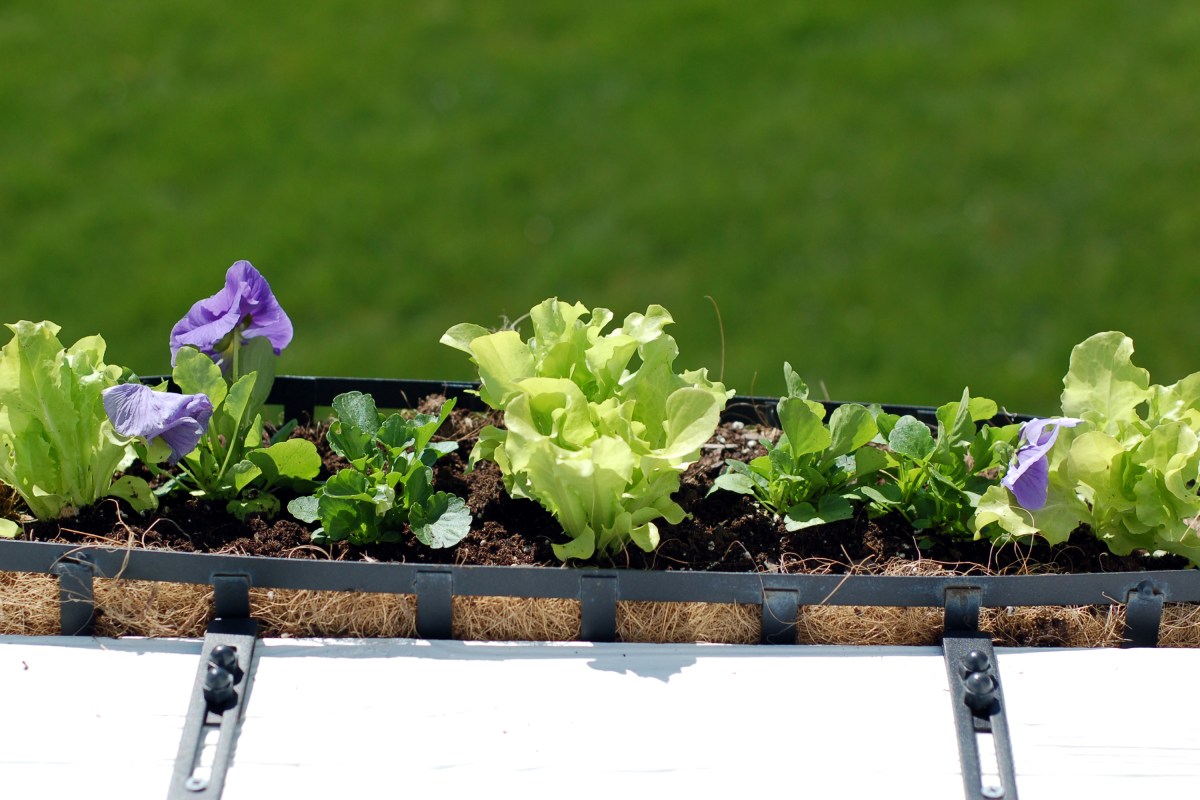
As I trickle clear water on pansies and lettuces, I see new flower buds that weren’t there when we bought the plants, new leaves that have sprouted since we planted them. It makes me kind of giddy.

It only takes a few minutes of my day. Each time I fill our lemonade pitcher with water and go out on the front steps to give the flowers a drink, I am struck that this simple act gives them life.

For the month of April, I will publish a 10-minute free write each day. Minimal editing. No story. Just thoughts spilling onto the page. Trying to get back into the writing habit.