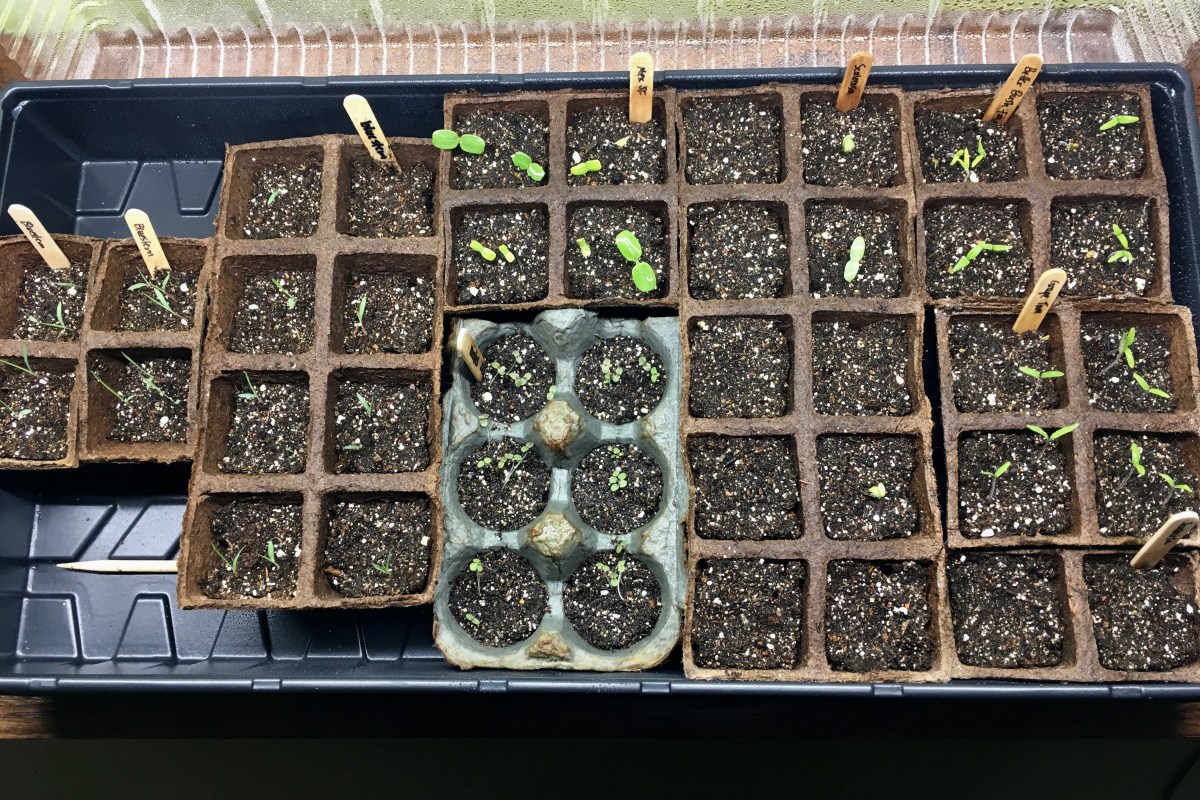
We planted these seeds on March 4, 7 days ago. The Mexican sunflowers and tomatoes started sprouting on March 9. They are growing under a shop light, I think it’s this 2.8 ft LED one.
Grape tomato seedlings
Mar9: first grape tomato sprouts
Mar9: first Mexican sunflower sprout
All the sprouts! Bluestem grass, violas, Scabiosa, Mexican sunflower, grape tomatoes, better bush tomatoes
I’m attempting to manage more than 2000 square feet of flower beds, starting half of that area from scratch and completely reorganizing the other half. My to-do lists are long, and I can’t remember everything I need to do. Or, as is more often the case, I get out there and start on the first true need, then get distracted by a thousand other things I also need to do, but aren’t as high priority.
So when I have a long list of things to do in the garden, and I don’t want to destroy my gardening notebook by dropping it in the dirt or spraying it with the hose, I take photos: of my list, of the bed designs, of the seed packets. Then when I’m out there, I know what I need to do, where plants need to move, and what depth to plant seeds.
I didn’t get to moving the Rudbeckia, pulling out the mint, or transplanting the hydrangea, and I decided to wait until it’s a little warmer to put the globe thistle in the ground, but we did get to these things:
– Pulled the purple vervain seeds out of the fridge (started Feb 11; should be able to expect seedlings sometime between March 18-25)
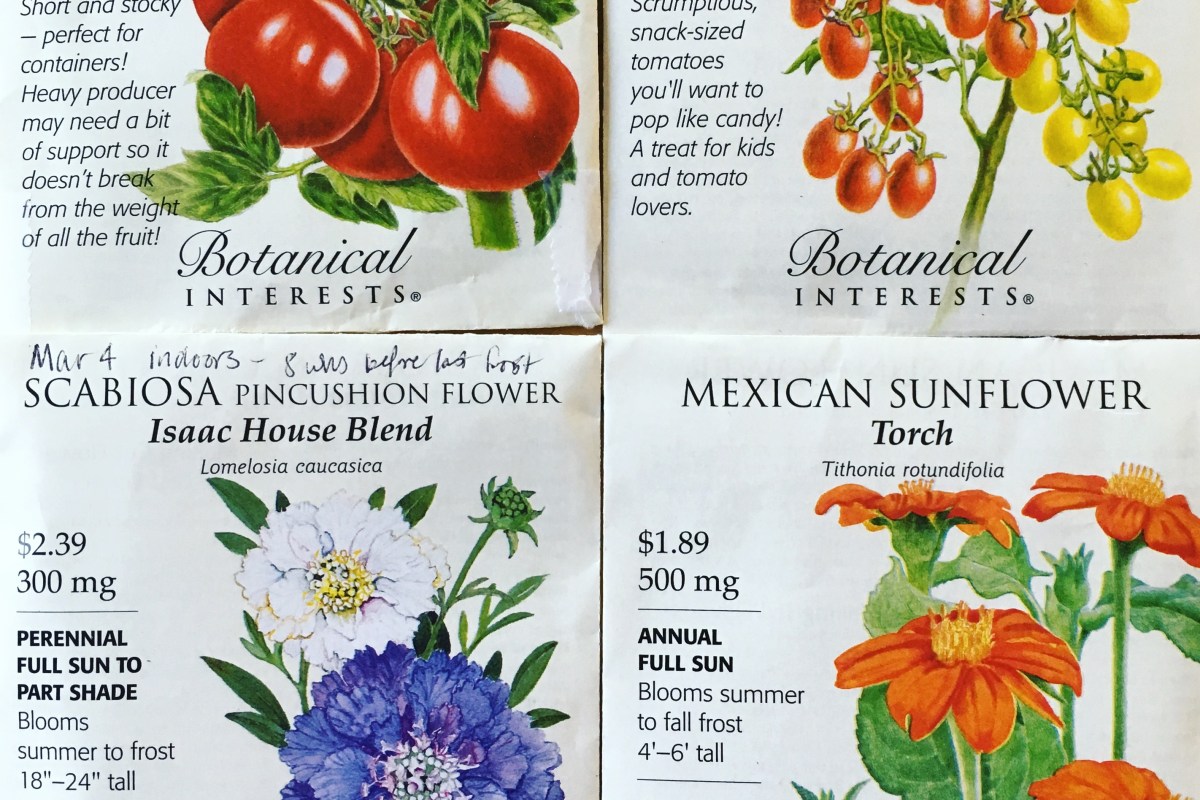
– Started indoors: Mexican sunflower seeds, Scabiosa seeds, and two varieties of tomato seeds.
– Transplanted 4 clumps of bee balm: 1 to underneath window on side of house, 1 to bed 3 and 2 to bed 4.
– Transplanted 2 Shasta daisies to bed 5.
– Son mowed grass.
– Daughter planted Liatris (blazing star) corms in bed 5.
– Daughter planted Crocosmia corms in bed 4.
– Trimmed lavender and transplanted to bed 5.
– Daughter planted tendersweet pea seeds.
– Finished erecting rabbit fence around veggie garden.
The high was 53 today, and the low tonight is expected to be 26. Now I just have to have patience to wait for the green. I hope everything survives!
Spring is near! It’s been in the 70s most of this week, and today, before a few days of rain set in, I did the following:
Transplants
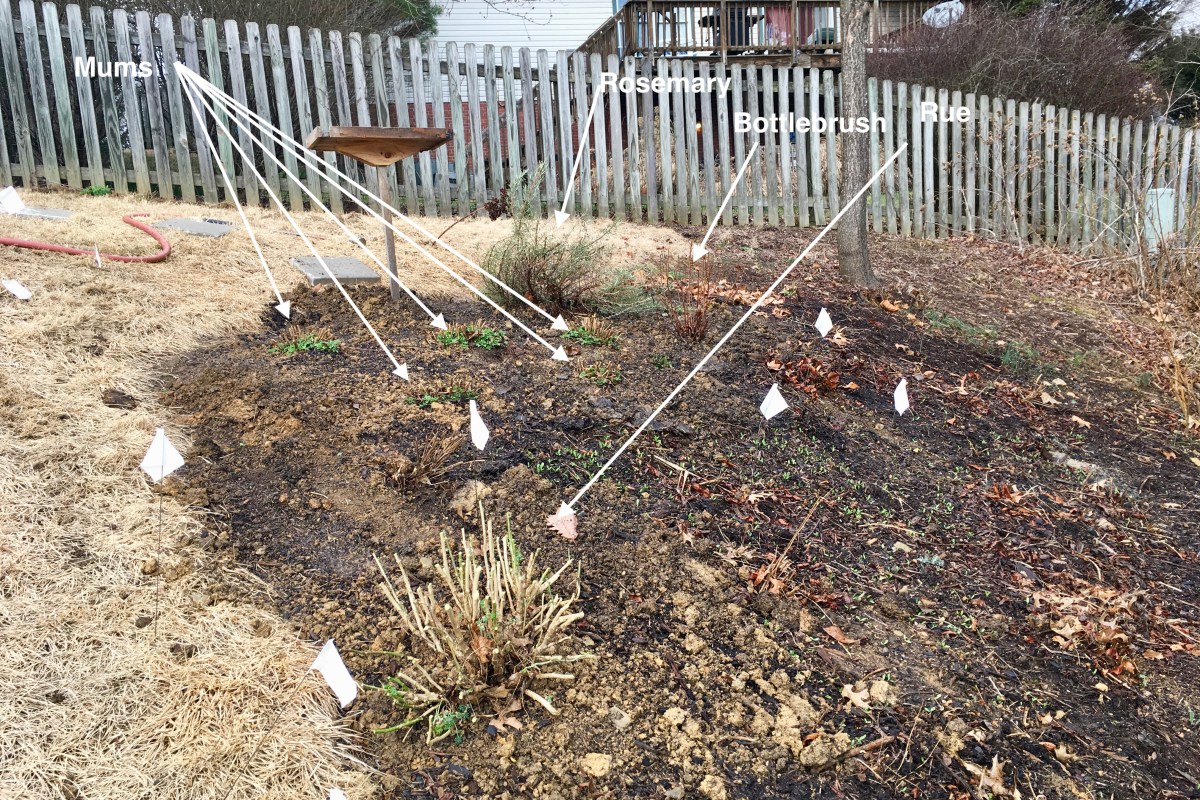
Transplanted 5 mums from out front to out back
Moved bottlebrush
Transplanted the only rosemary that still looks alive to out back by the birdfeeder. I’ll be surprised if this survives> I think I brok off some of its taproot, and the hole I dug for it wasn’t deep enough for its root. The shovel kept hitting gravel, making it difficult to dig any deeper. It also had very little root system, and no dirt clung to its roots when I moved it.
Transplanted a rue to the hill. Even after cutting it back, the rue was massive — probably a 2′ diameter disc of soil and roots
Consolidated 5 scattered creeping phloxes into a clump next to taller phlox out front.
Seeds
Last night I scraped each blue bonnet seed across an emery board to rough up the surface, then soaked the seeds in boiling water over night. After moving the mums and rue out of the way where I wanted to plant the blue bonnets, I smoothed the dirt as much as possible and drew a pattern in the soil for where I wanted to plant each seed type.
Bluebonnet bed out front
I sowed chamomile, feverfew, and blue bonnet seeds and sprayed them in. Coreopsis seeds need to be sowed when it’s warmer. I can expect the seeds to sprout anywhere from 10-25 days from now, depending on the weather. It may take longer, but I think now that they’re out there they can make their choice about when to emerge.
Colder weather is coming — it will still be warm during the day but will drop below freezing at night, so we’ll see how everything does. Here are some photos of what the garden looks like in late February:
I’m finally able to start gardening! I took a flex day on midwinter day (also known as Imbolc, Candlemas, and most familiarly, Groundhog day), and since the kids also had a snow day, my daughter and I drove to Lowes and Home Depot to pick up seed trays, seedling-starting soil, and a shop light for when the seedlings emerge and need light. I bought a large rectangular Gladware container that will eventually be good for storing cupcakes, but for now I am using it to hold the seed pots so I can refrigerate them. I also ordered more seeds 😬.
After making some midwinter cutout cookies with the kids, I started the first round of seeds, which need to be started indoors 10-12 weeks before our average last frost date (April 29 in our area).
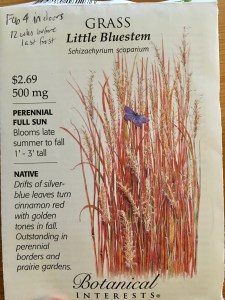
Little Bluestem grass
Poured dry soil into the Gladware container, then wet it using the sink sprayer. Stirred it until the soil was evenly damp, then spooned the moist soil into plantable pots.
Sowed 4 seeds in each of 12 plantable pots that came with our seed starter tray: dropped 1 seed in each corner of each pot, then poked them in with a cake pop stick.
Poking Little Bluestem seeds into damp soil with a cake pop stick
Pressed soil down to make sure seeds were not in air pockets and were in contact with damp soil
Squirted the top of each pot with a spray bottle
Placed in large rectangular plastic container and snapped all but one corner of the lid to keep moisture in but not make it air-tight.
Put container in fridge.
Need to stay in fridge 3-6 weeks, and must remain moist.
Violas (Johnny Jump-up) Inside
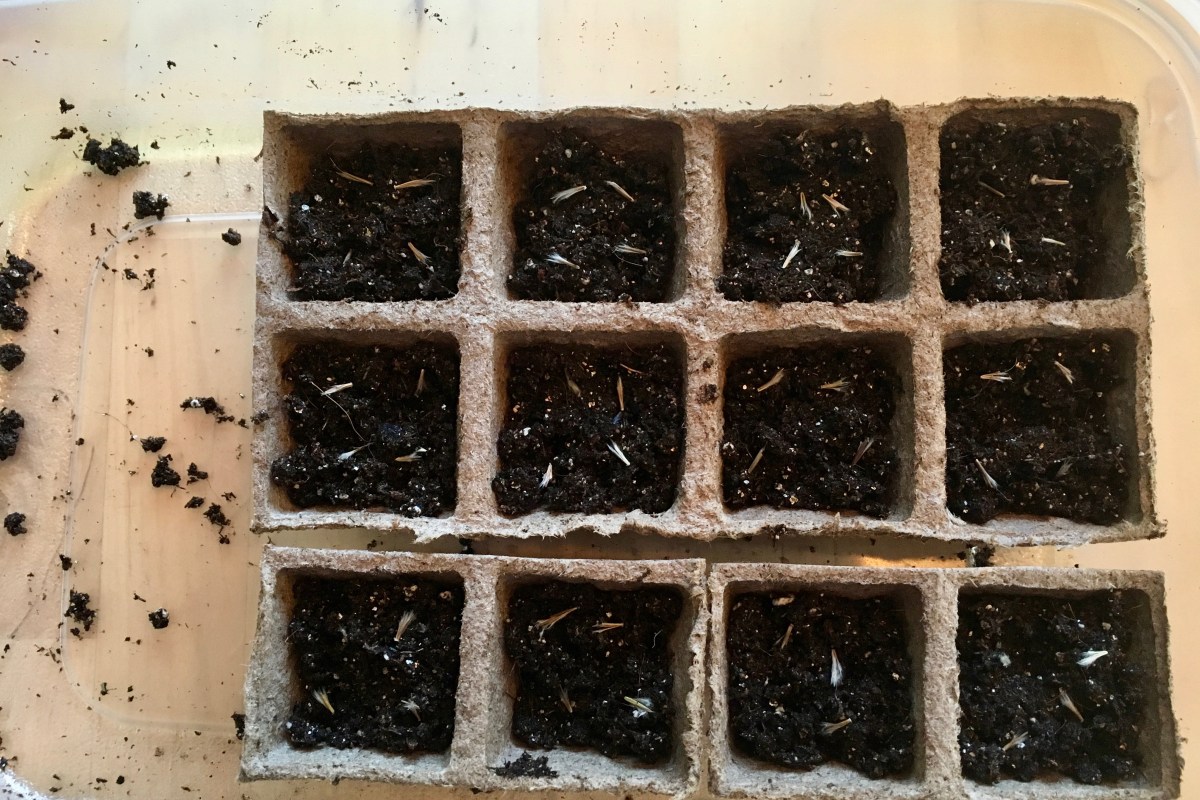
Used the damp soil mixture from above and a six-pack recycled paper board egg carton (hopefully plantable) to plant seeds.
I used the egg carton, with the carton lid, to provide the seeds with darkness, which they need to germinate.
Viola seeds were tiny. I scattered them over damp soil in the egg carton, probably 5-7 seeds per pot.
Tamped soil, sprayed with water to make sure soil was wet through with no air pockets around the seeds, then closed the carton lid and placed them in the plastic container with the Bluestem seeds.
Violas (Johnny Jump-up) Outside
We’ve got snow and rain due tomorrow, and since these are early spring bloomers that need cold before sprouting, I figured I’d go ahead and scatter the rest of the seeds outside where I want them to grow (under the tree at the top of the back hill) and see if they emerge in spring.
The ground is not frozen, at least at the surface, and I loosened the top 1/2 inch of soil in about seven 8″ patches.
I sprinkled 5-7 seeds in each disk, then covered them with soil and tamped it down. The soil was moist.
I did not water the seeds in. It’s supposed to snow, then rain, then freeze tomorrow, so we’ll see if this works.
Seedlings are supposed to emerge in 12-25 days at 65℉, then bloom 90-100 days later.
I read on Botanical Interests‘ site, the place I bought my seeds, that I should start little bluestem indoors 10-12 weeks before the last frost (April 29 in our area):
When to sow outside: 2 to 4 weeks before average last frost. Can be sown in the early fall so plants get established before winter and get an early start on spring.
When to start inside: 10 to 12 weeks before average last frost.
Special germination instructions: Germination may improve if seed receives a cold treatment. See inside of packet for detailed information.
When I opened the packet for more information, I read that the seeds need stratification when started indoors in the spring:
When starting seed indoors in spring, sow the seed into a container of moistened seed starting mix, cover with clear plastic wrap and leave the container in a refrigerator for three to six weeks, then remove to a warm location. Always keep soil evenly moist.
inside Little Bluestem seed packet
I’m not sure how many to plant, though — if I want the grass to take up 1.5 feet in diameter, how many seeds do I plant and in how many pots?
Oh wait, on the packet it says:
Seed depth: 1/8″ – 1/4″
Seed spacing: a group of 4-6 seeds every 1′-2′
Thinning: when 2″ tall, thin to 1 every 1′-2′
So if I want 10 1′ clumps, I should probably start 12 small pots, each with 4 seeds. Okay, I think I’m good for bluestem.
Viola Johnny-Jump-Up
We don’t have a lot of shade on our property, which I love — more sun means more flowers. We do have a shady spot up on the hill though, and I thought it’d be fun to put some violets up there. Instructions for how to start Johnny-Jump-Up seeds are all over the place — some say they need stratification like mentioned above, some say to start them in a warm place — so I’m not sure what the best approach is. Since they are an early spring bloomer, I’m going to go with the cold treatment.
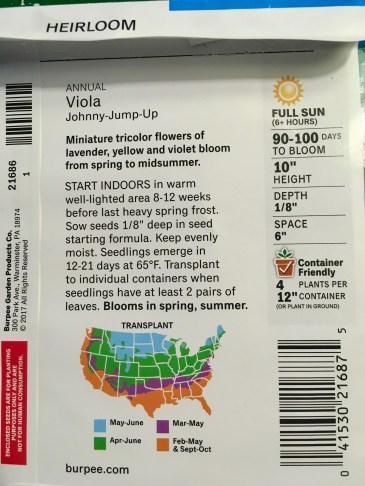
The seeds I bought are Burpee seeds, so I looked at Burpee’s instructions which read:
Sow indoors 8-12 weeks before the last heavy frost using a seed starting kit. Violas can take a light frost. They may also be started late summer for fall blooming.
Sow seeds thinly and evenly in seed starting formula. Cover completely as seeds need darkness to germinate; firm lightly and keep evenly moist.
Seedlings emerge in 10-14 days
As soon as seedlings emerge, provide plenty of light on a sunny windowsill or grow seedlings 3-4 inches beneath fluorescent plant lights turned on 16 hours per day, off for 8 hours at night. Raise the lights as the plants grow taller. Incandescent bulbs will not work for this process because they will get too hot. Most plants require a dark period to grow, do not leave lights on for 24 hours.
Thin to one seedling per cell when they have two sets of leaves.
Seedlings do not need much fertilizer, feed when they are 3-4 weeks old using a starter solution (half strength of a complete indoor houseplant food) according to manufacturer’s directions.
Transplant hardened-off seedlings to the garden after the heavy frost.
Before planting in the garden, seedling plants need to be “hardened off”. Accustom young plants to outdoor conditions by moving them to a sheltered place outside for a week. Be sure to protect them from wind and hot sun at first. If frost threatens at night, cover or bring containers indoors, then take them out again in the morning. This hardening off process toughens the plant’s cell structure and reduces transplant shock and scalding.
I’ve cleared another 1000 square feet of our property for flower beds instead of lawn, and since it’s on a steep hill and I want it to be relatively low maintenance, I’m trying to find drought tolerant plants that attract butterflies and birds, that will hold the hill in place, and that won’t cost us a fortune to establish.
I also have about a million plants I want to try because I keep seeing them in books and magazines and I love them (globe thistle), or I hear they’re a must have for butterflies and hummingbirds (anise hyssop), or because we had a few come up from the wildflower mix last year and I want more of them (bachelor’s buttons).
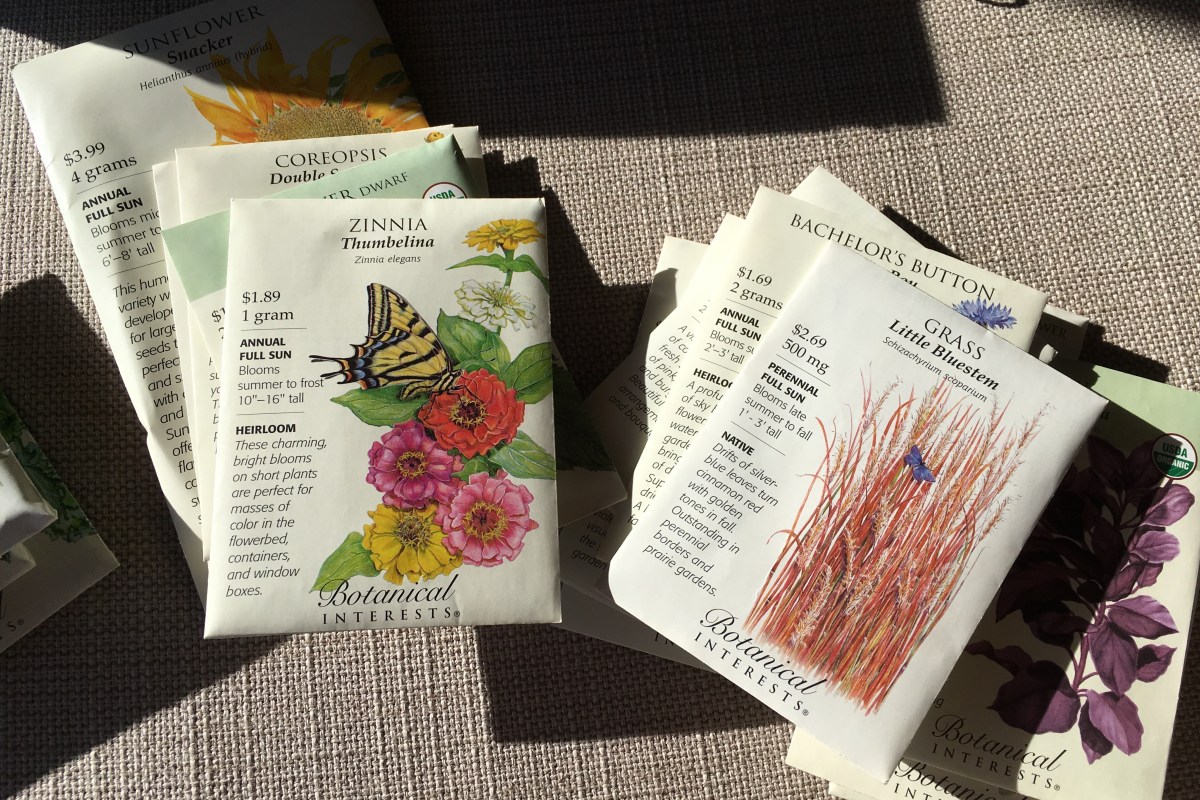
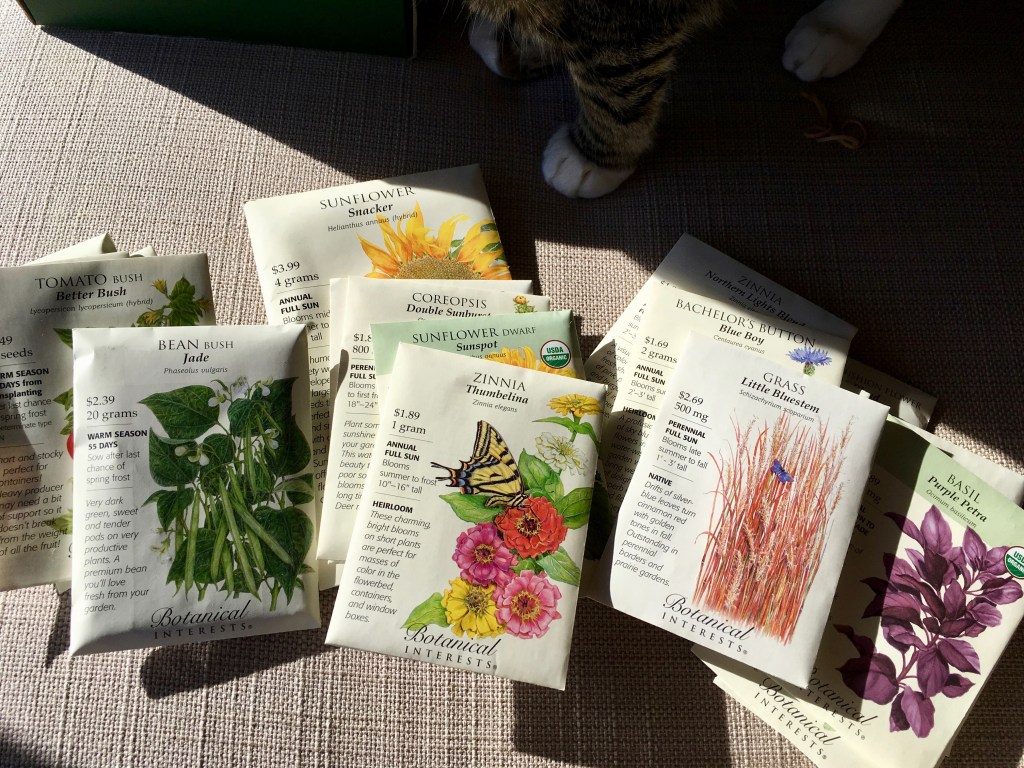
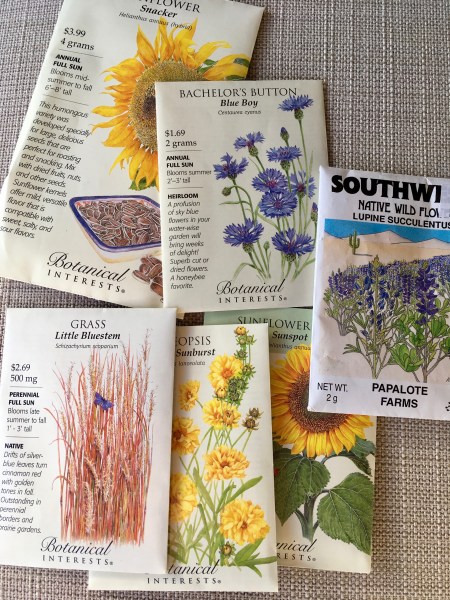
Since buying everything I want as fully grown plants would cost almost as much as a used car, I researched what I could start on my own and bought seeds. I’ve been waiting a week for them to get here, and they finally arrived!
Mostly flowers, but we bought some herb and veggie seeds too
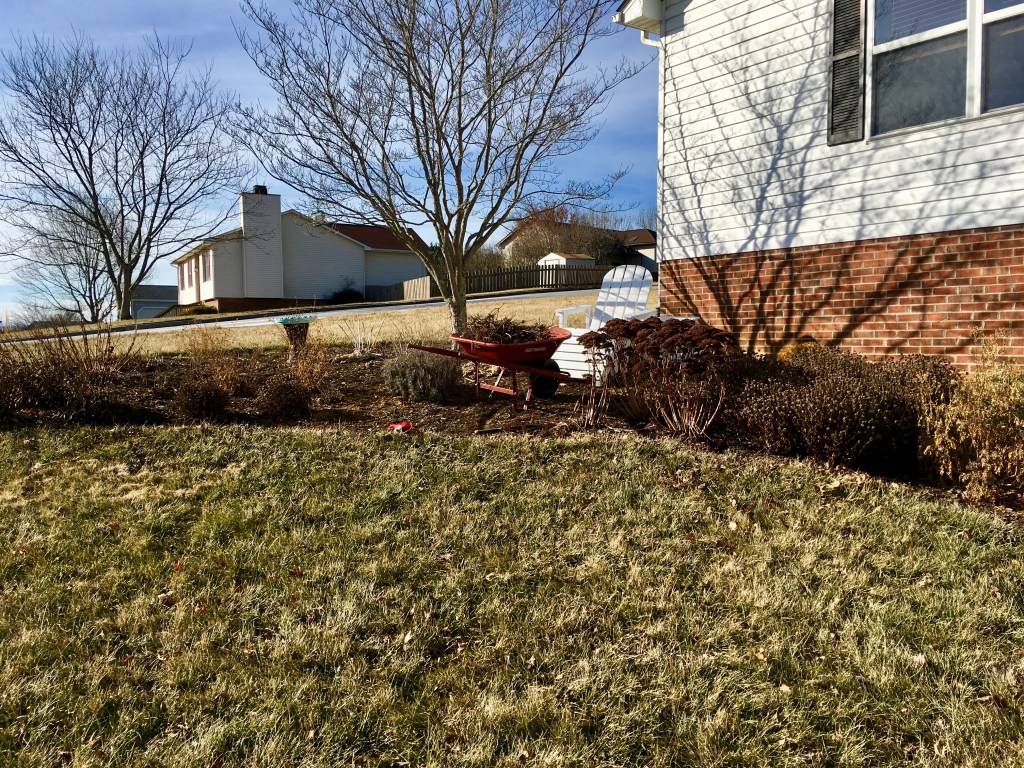
I cleared out some of the brush last weekend — old seed heads from Sedum, dried stems from mums — to prepare for the coming planting season. I probably should have done that in October or November, as the garden looks much tidier now. I wanted to leave the seeds for birds, though, so I was torn between having neat beds and providing food for winter friends. I think it might look more depressing without the dried plants than it did with them still intact, as it’s now very bare, so I’m not sure which I like better.
Either way, I think it might be good that I didn’t cut everything back in the fall: the remaining stems collected dry leaves and created an insulating blanket for their roots in these cold temperatures. I’ve read it’s good to mulch perennials in the fall to protect the roots, and since we didn’t do that, maybe my autumn neglect turned out to be a good thing.
Clearing out the dead, dry stuff
That’s about the extent of what I could do outside in December and January, so over the past few weeks I”ve spent a lot of time inside thinking about the garden, poring over gardening books and magazines, popping outside to measure, drawing plans, and then browsing catalogs.
Now that I have these beautiful seed packets, I’m even antsier for spring to come so I can start planting. I keep trying to visualize what the beds will look like when plants come in, and I’ve got a calendar for when to plant what and where. I’ll be able to start some seeds indoors in just a couple of weeks.
Blues and yellows for in front of the housePinks and purples for front and back
My biggest questions right now, besides how to make the time go faster, are what kind of seed starter to use — peat pellets or pots with soil? — and whether to buy a grow light. I read something about seedlings needing 14 hours of light, which they won’t get in my basement office, so I think I still have a bit of research to do.
That should kill an hour or two in the zillion hours between now and April when I can get outside and start gardening.
I went outside to pull a couple of weeds this morning and wound up in the garden until dark, cutting back milkweed and blackened echincea. The autumn debris pickup is this week, so I’m trying to get all finished-for-the-season stuff out to the curb.
I also cleaned up the herb garden. It was all wrong. There was no harmony of height, shape, or color, and I couldn’t handle the chaos anymore. Low herbs like the silver mound Artemisia and the lemon thyme had spread such that greenery ringed the old woody stems at the center like a donut: the plants were bare in the middle. The spacing of the plants within the bed was off as well, with random dense clumpings adjacent to bare swaths of dirt due to plant losses during the year (catnip, rosemary).
I ripped out all the creeping thyme — it was unattractive and taking up valuable real estate — then didn’t stop pulling things out of the ground until I’d moved every plant in the bed except the roses.
Reorganized herb bed. I hope everything survives. Or at least most of it does.
Moved goldenrod from herb bed to back of the big bed next to the other goldenrod, behind the bee balm.
Divided the two giant clumps of lemon thyme into four clumps each; spaced the new smaller clumps along the border by the driveway. Also put one down by the street and one in the mailbox bed.
Divided the silver mound Artemisia in four; place three around the edge of the mailbox bed, and one by the street in the herb garden. The mailbox placement is likely wrong. I’ll need to adjust next year if they survive.
Moved the baby rue cuttings to the back, by the lawn and between the three rose bushes.
Divided the marjoram in four; placed two alternating between thymes by driveway, placed one by redbud (ripped out lemonbalm — it was the wrong height for that space), and moved one down by the street.
Moved penstamon from street to house edge of herb bed so we can see it from the window
Moved all three lavenders: they were taller than the rose behind them, and their spacing was weird. Moved one to the back of the herb bed next to the black-eyed susans, moved one to the center of the fat part of the herb bed, and moved one over by my chair in the other bed (the guara I transplanted next to my chair died).
Moved the little yellow tickseeds to the edge of the herb bed, by the driveway and spaced between the roses.
Cut a couple of clumps off of the lemon balm and moved them over to the back of the big bed; ripped out the mums that were there and replaced them with the lemon balm.
Moved a Russian sage from down by the street to between the two roses closest to the house; this looks like it may not have survived the transplant.
Planted a rosemary between the two roses closest to the house.
Another view of the tidied herb garden. I wish we had mulch Everything has room to grow. They won’t fill in their allotted space next year, but maybe the year after that.
Now I need to study my gardening books to see when I’m supposed to prune the roses and other shrubs.
The monarch caterpillars are getting fat. During the eclipse, I walked around the garden inspecting the undersides of leaves, taking inventory. I counted 11 or 12 monarch caterpillars on the milkweed, along with 3 swallowtail caterpillars on the rue and the parsley. The milkweed looks terrible — it’s gone to seed and is covered with aphids and big orange bugs that are eating the aphids. The echnicea looks terrible too — brown and fried — but in the mornings, goldfinches perch on the dried heads and sway while they eat coneflower seeds.
Dying, drying coneflowers for the goldfinches
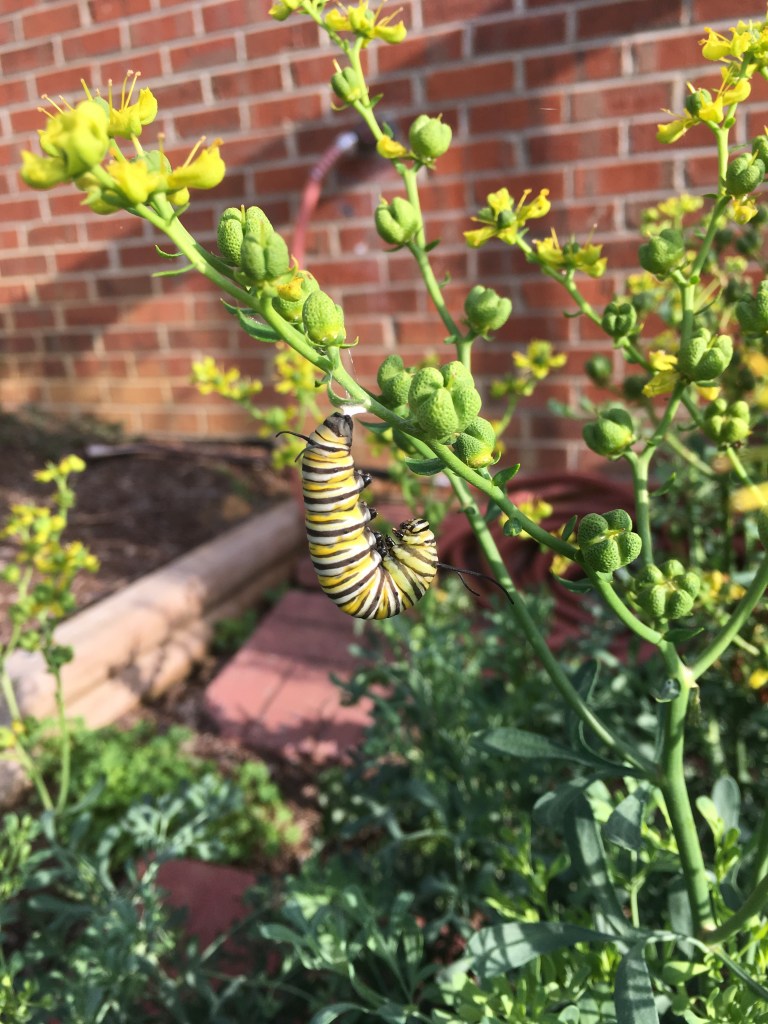
The monarch caterpillars are drawn to the rue for making their chrysalises. I have been surprised by how popular the rue is.
Monarch caterpillar pre-chrysalis
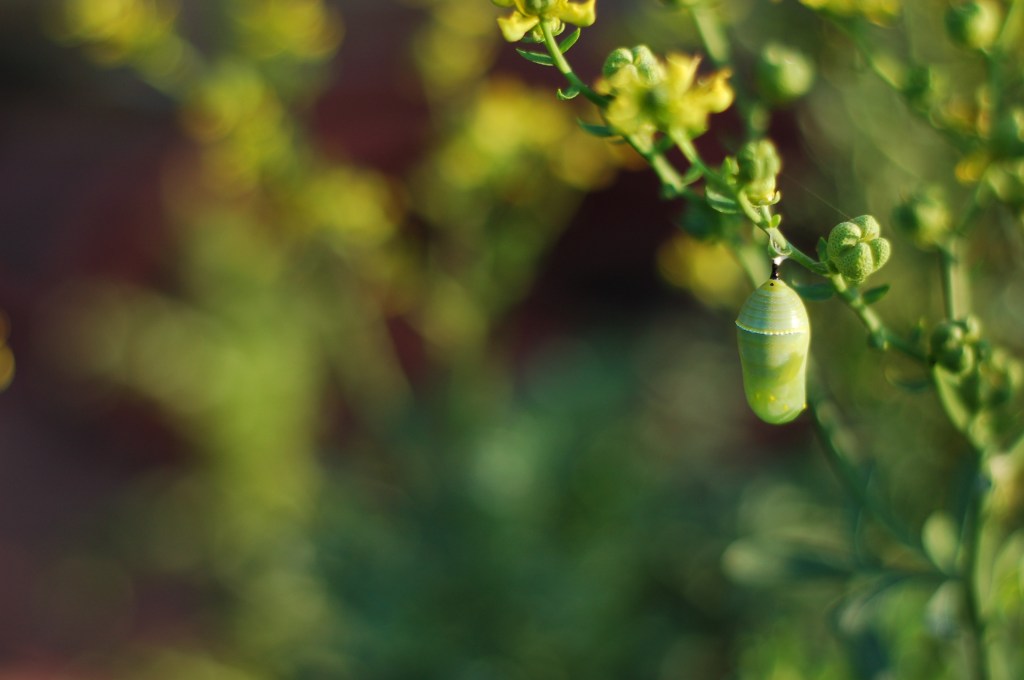
It currently hosts swallowtail caterpillars who are eating it, and monarch caterpillars who are hanging in their chrysalises from it.
Same monarch caterpillar later in the day
And just because I like to check in each year to see what the status of all the plants were in prior years, here are some photos from the garden in late August:
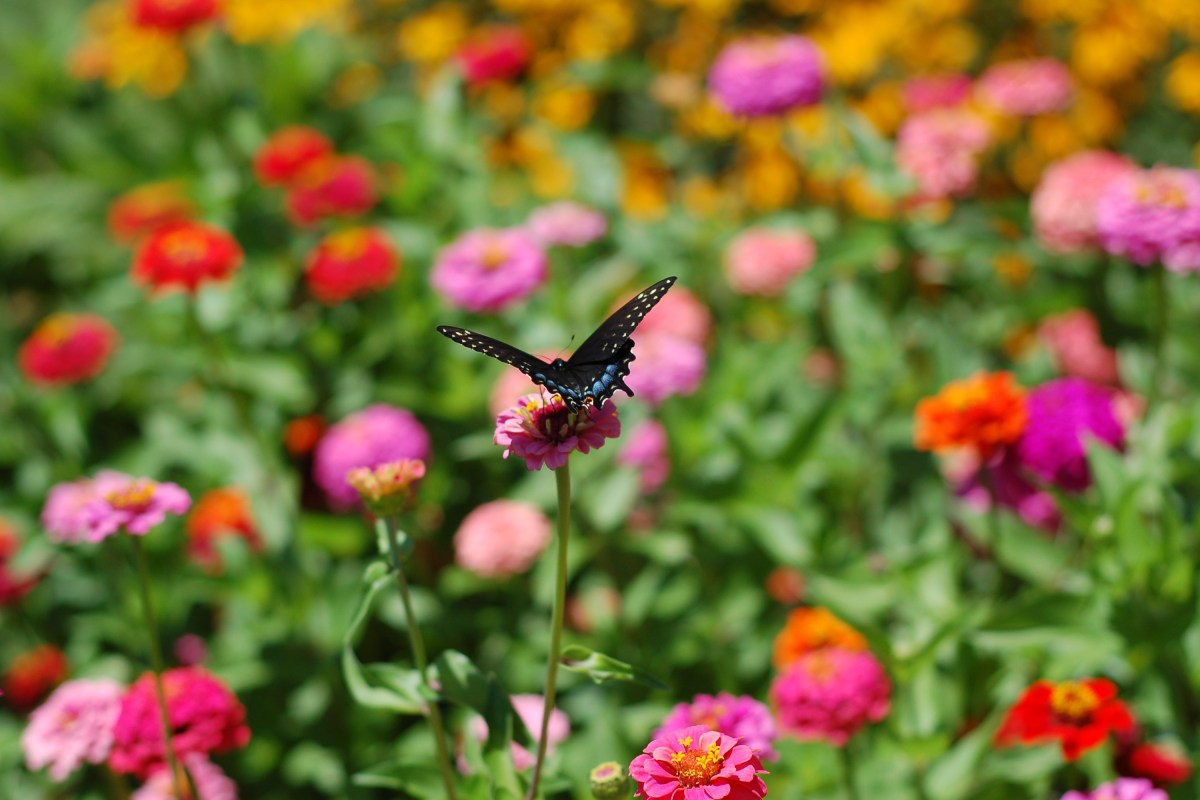
Before we sailed yesterday, I spent several hours in the garden, sitting under the dogwood tree, reading butterfly books, and photographing all the butterflies that came to visit the zinnia patch six feet from my chair. There were moments when the zinnias hosted monarchs, swallowtails, painted ladies, skippers and a hummingbird all at the same time.
The day was dry, the sky cerulean, a breeze blew the butterflies and flower heads, and the temperature was a comfortable 77° F. The zinnias were most hopping at about 2pm.
View from under my dogwood tree
Bumbleebee
Silver-spotted skipper
Sulphur — clouded?
Monarch and swallowtail
Hummingbird
Flower box and blue sky
Painted lady
Painted Lady
I went out at the same time today. The sky is cloudier, it’s warmer, and I mowed the grass. The large butterflies are just not here today. I wonder why.
By August, our flower boxes are usually brown and desicated. Somewhere along the way we had forgotten to water, and in summer sun and heat, it doesn’t take long without hydration for the plants in these tiny boxes to shrivel and die.
This year I lined the coconut liners with plastic and I water them every day. And, what do you know, it worked! I put these plants in the boxes on July 2, and here they are a month later, still alive. It’s amazing what the basic necessities of life will do.
Front bed and flower boxes
Flowers on the stairs
Marigolds, sweet potato vine, and marjoram (or oregano?)
In other news, the rue cuttings I started on May 19, and put in the ground sometime in early July (maybe the same day I planted the flower boxes), have new growth! Only one of the cuttings actually had baby roots when I transplanted them into the earth, but now two of the cuttings have survived, put energy into their roots, and are finally starting to make new leaves as well.
I also planted a phlox — Phlox paniculata ‘Younique Old Pink’ — after the kids and my husband came home from a hike a few weeks ago and my son said, “Mom! Do you have any phlox in the garden? We saw some on our hike and it was _covered_ in butterflies.”
Of course I had to have some.
I’ve been on a hunt ever since. It was in every nursery in the spring, but late July and August are not really gardening season, so none of my regular suppliers had any. I found some at Lowe’s today and grabbed one. I planted it next to my chair, under our bedroom window. It is quite fragrant, and I can’t wait until we can open the windows again and smell it from inside.
Phlox flowers after planting and watering
Younique Old Pink Phlox
New rue growth
New phlox in the ground
Everything is in bloom, and I love it. I spent much of my day off today in the garden, watching butterflies and enjoying the summer abundance. I need to get out my real camera to capture some of this beauty so I can keep it for winter.














 I read on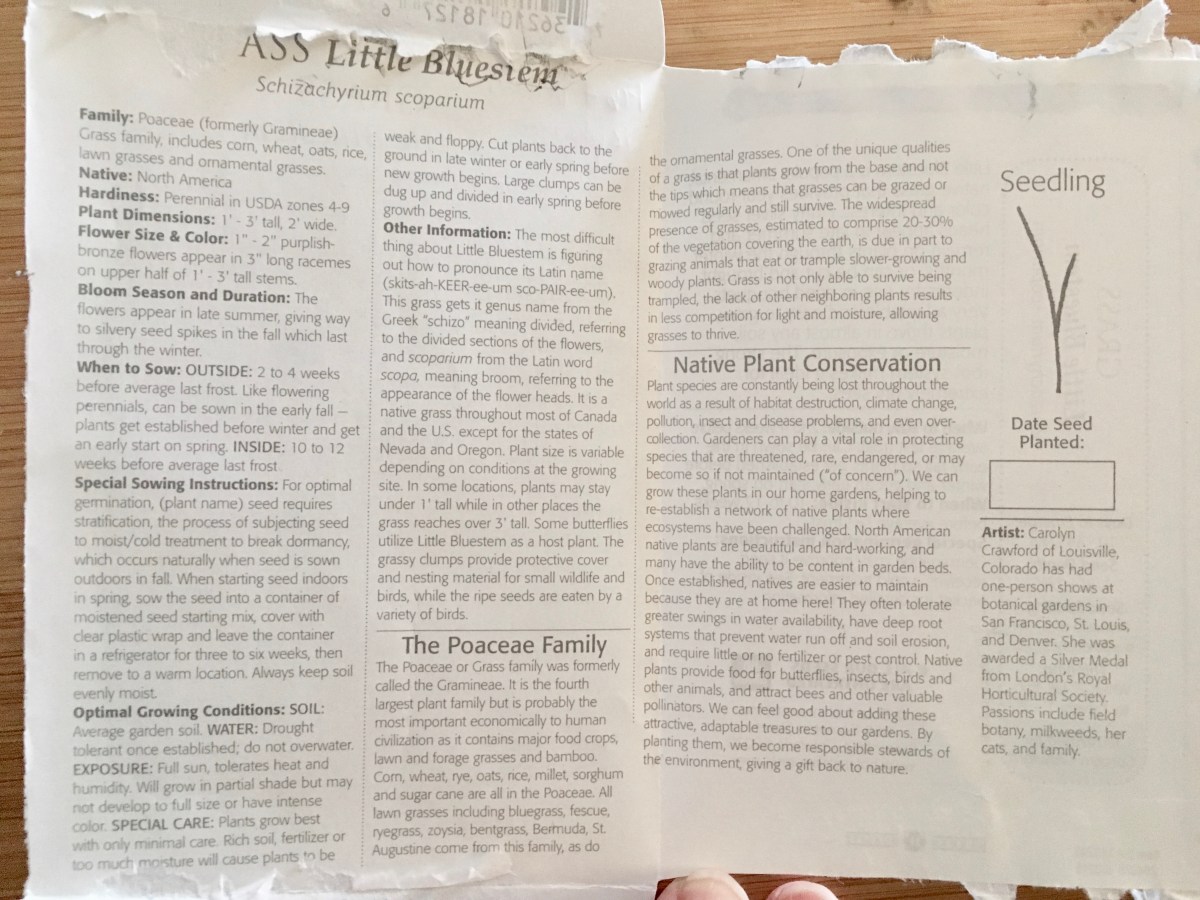









 Andrea's Gardening Blog