Building a flower bed (Killing Grass: Round 2)

My skin is pink and warm. I spent all weekend outdoors, in the garden and on the soccer pitch.

The fresh air, dirt, and blue-sky matches were totally worth the sunburn.

Our neighbor has a farm truck and told us these past weeks that he would soon fill it with a (literal) ton of mulch; he wouldn’t need it all, and would we like to split a truck load with him? He dumped the mulch Wednesday, and on Saturday, our daughter and I drove around town collecting cardboard and newspaper: we were going in for round two of killing the lawn so we can put in a flower bed.

Our first attempt at killing grass with garbage bags failed, so we pivoted. We did some research, and I think we have a better chance of succeeding this time with compostable materials that worms can eat instead of ugly black plastic.

In preparation, my husband lowered the mower blade as low as it would go, and cut a curved shape in the lawn where the flower and herb beds would soon go.
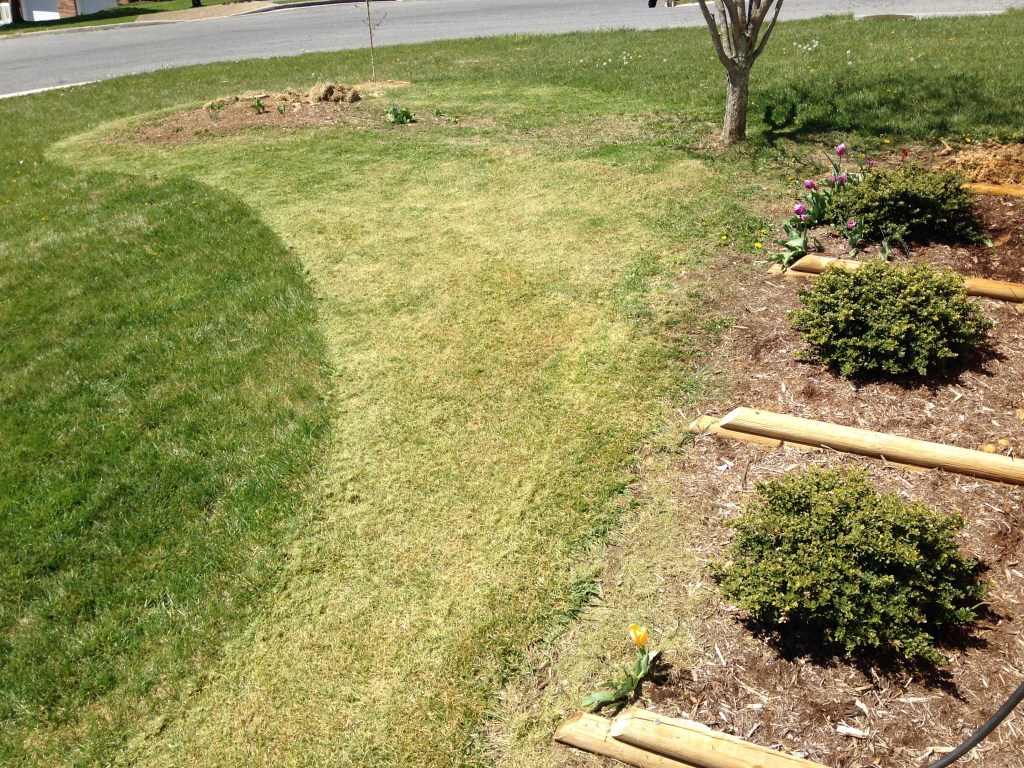
shorn grass for flower bed
Shorn grass for the front flower bed.

Our daughter has been as eager to get out in the garden as I am, and she helped me cover the soon-to-be-dead grass with cardboard and newspaper.

watering cardboard 17
Laying cardboard over close-cut grass to smother it.

We watered the cardboard to soften it, then covered it with mulch. The mulch weighs it down and will also hold moisture, hopefully keeping the thick paperboard damp to help speed up the decomposition process. We covered gaps and filled out the shapes with layers of newspaper 4-6 sheets thick, then watered the mulch and papers again.

mulch on newspaper 19
Mulching over cardboard and newspaper to kill lawn.

We ate through half the chipped bark and wood before our neighbor even touched the ton pile. Even though I hated to stop, we got through two rows of cardboard and newspaper before I reluctantly quit working so we didn’t use all the mulch.

curves of the bed 41
Weighting down the edges while we wait for more mulch.

Our neighbor has said he will gladly get another truckload to split with us, so I’m excited for next weekend, when I hope to get through another section of the soon-to-be flower bed.

I was so happy to be outside, I barely remembered to eat. I made a quick peanut butter and jelly sandwich and ate it on the front steps. I wanted to look out over the yard, what we’ve done, and what we’ve yet to do. Each time we drove up to the house — after soccer, after our daughter’s hair cut — I smiled and did a little dance for our house and garden.

flower bed so far 40
Stopped. For now.

Our daugher and I spent a lot of labor mulching our new plantings, laying biodegradable cardboard and newspaper over unwanted grass, and watering everything in. It’s going to be important that we stay on top of it — keeping everything wet to encourage both growth and decomposition.

I’ve been ignoring those mid-morning calendar reminders to “Water plants” every day for months. We didn’t have anything alive at the time I created the reminders, but I set them knowing this day would come, and I’d need to make sure I made time to nurture plants.

It is spring now, and the weather is beautiful. I’m ready to start taking a break each day to get outside and tend the garden.
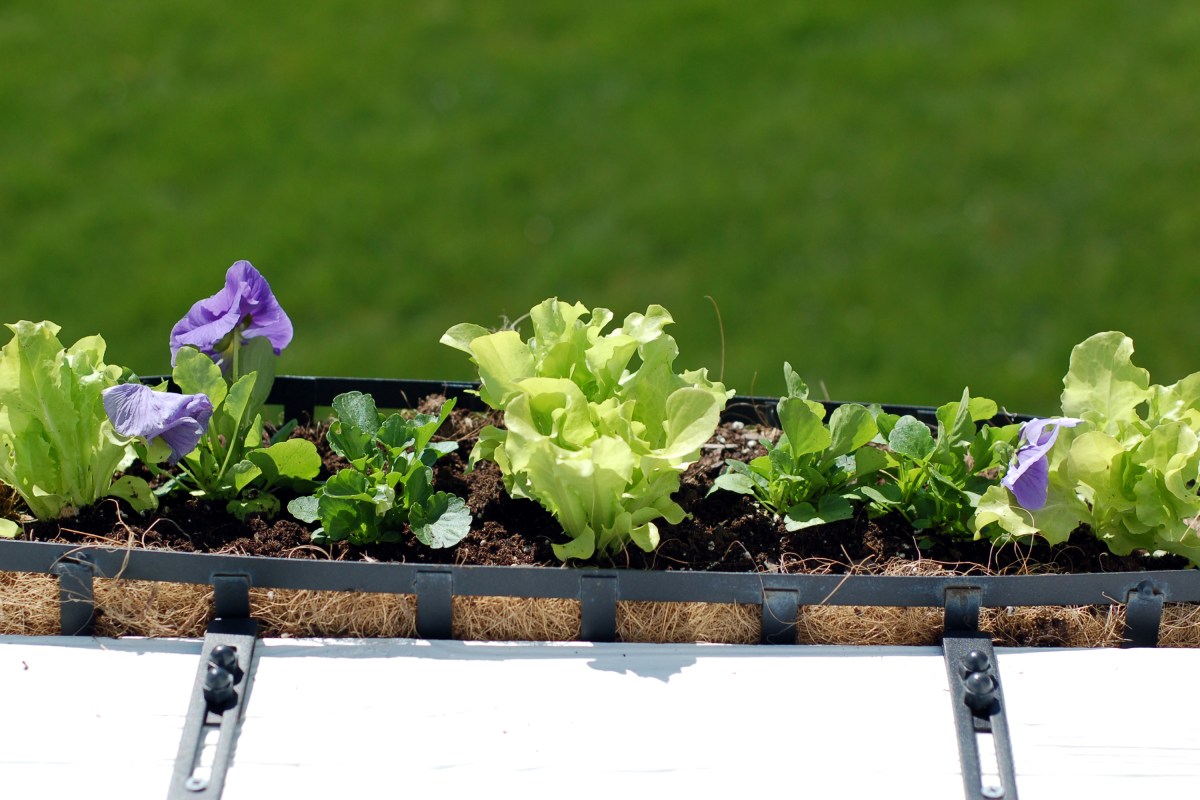
The things we focus on are the things that will flourish

I know this has been said a million times before, and is cliché, and everyone is already familiar with the concept of nourishing the appropriate areas of our lives that we want to grow, but I am still astonished by it when I garden: when we take time in our lives to pay attention to something, that thing will prosper.

This is true whether we cultivate our craft by carving out time to write or photograph or woodwork; our relationships by spending quality time with the people we love; or our worries, making them larger and more real in our lives for the care and feeding we give them.

But nowhere is it so clear to me, so real, as when I water plants. Perhaps this is because I see what neglect results in as well: withering. Decline. Death.

As I trickle clear water on pansies and lettuces, I see new flower buds that weren’t there when we bought the plants, new leaves that have sprouted since we planted them. It makes me kind of giddy.

It only takes a few minutes of my day. Each time I fill our lemonade pitcher with water and go out on the front steps to give the flowers a drink, I am struck that this simple act gives them life.

For the month of April, I will publish a 10-minute free write each day. Minimal editing. No story. Just thoughts spilling onto the page. Trying to get back into the writing habit.

Early April in the garden

Finally! We can play in the garden! Well, I guess we did some back-breaking labor a couple weekends ago, digging forsythia stumps out back, but that wasn’t playing. That was work.

This weekend, though, I refilled our dead brown flower boxes with fresh new greens, and we put plants into the ground instead of taking them out.

Brown dead flower box
Sad dead flower boxes from September
lettuces and purple pansies in a flower box in spring
April planting: lettuce and purple pansies

It was one of those spring days that looks gorgeous when you look at it through a window: crystal blue sky with tiny puffs of clouds. Outside, it was also gorgeous, but gusty with wind. Our daughter and I were constantly putting sweatshirts on, and taking them back off. Putting them on, taking them off.

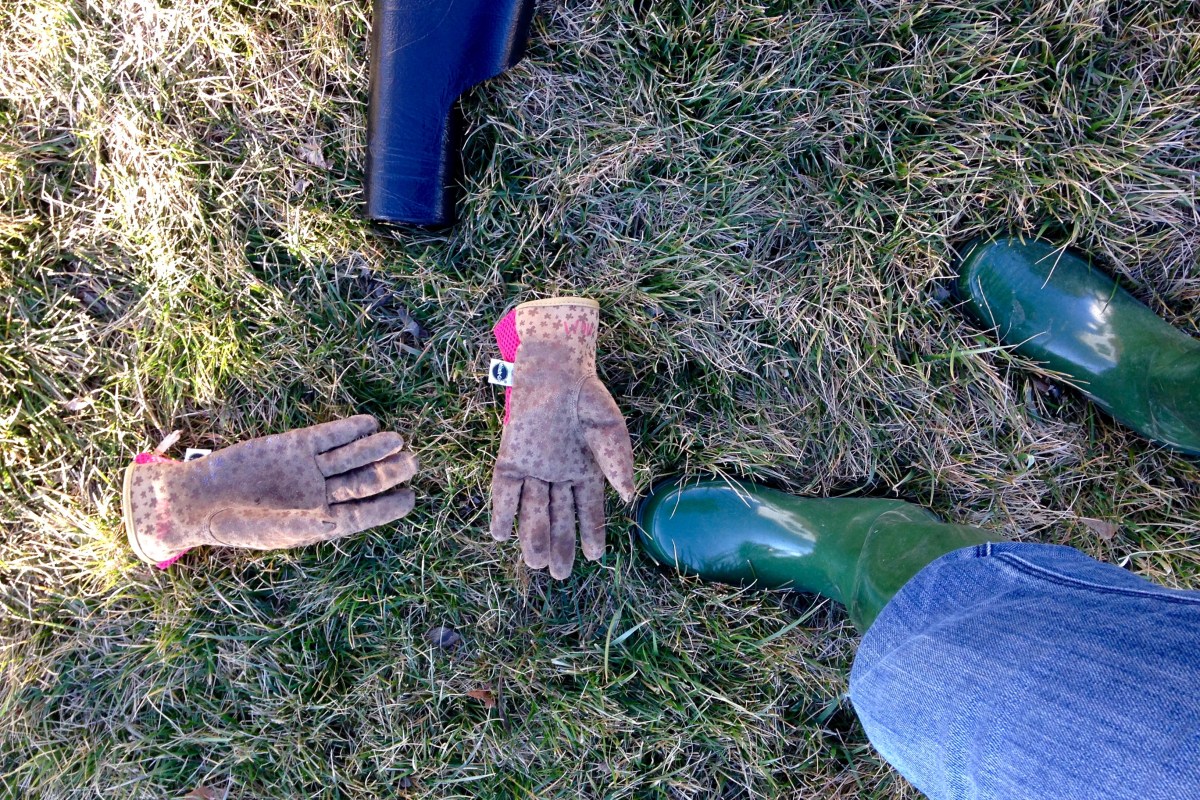
Garden gloves and blue sky
Gardening gloves and blue April sky

And I was forever distracted by flowers in the garden. We spent 3 hours digging holes that probably could have taken 30 minutes, but — flowers!

Red tulip in April
Red tulip from previous owner

We didn’t live in this house last spring, so we weren’t sure what kinds of bulbs might be here. Apparently there are tulips. Only one has bloomed so far, but there are fat buds on others. I can’t wait to see what colors they are.

dogwood42
Dogwood blossom

Dogwoods are one of my favorite trees, and I was giddy to see green buds on ours. I can’t believe I was able to capture a focused image with the wind blowing as hard as it was — the branches wouldn’t stay still.

redbud_13
Our new redbud

We added more flowers to the garden as well, with our new redbud tree, and our new blueberry bushes. Which we did actually dig holes for and plant.

Holes for blueberry bushes
Digging holes for blueberry bushes

Killing grass: we're pivoting

As I suspected, research would have helped with my attempt to murder our grass convert lawn to garden. I spent a warm Saturday cutting black garbage bags open, hauling bricks and stone edgers, and fighting with crinkling sheets of plastic in the wind while I tried to anchor corners and smother grass.

Four days later, at least five corners had dislodged; sled-sized patches of bright green grass grew happily towards the sun. Growing grass bulged under the billowing bags while a friend overseas asked, “How’s the grass-killing going?”

When I told him I didn’t think it was working, he sent me an article on No-Dig Gardening. “The hippie way,” he said. Another friend said his dad used newspaper, then covered the newspaper with mulch, instead of using plastic.

This didn’t occur to me, to smother with materials that worms can eat, that will decompose, that will become a part of life instead of a blocker to it.

On Friday, it was warm and sunny, and I decided to undo all the work I did last weekend. I pulled up the plastic only to see how ineffectual it had been. The bricks and edgers succeeded in killing some grass, but the plastic did not.

I stacked the bricks, threw the plastic away, and started reading about happier ways to kill grass.


Killing Grass

gardening boots and gloves

On Sunday, in the late afternoon after a run, when the sun was shining and the sky was blue, I dug out my gardening gloves, whacked last year’s crusted dirt off of them, and got to work in the “garden.”

I use air quotes because it’s not a garden yet. Right now our “garden” is a huge swath of gras: grass that last year had to be mowed, and grass that currently occupies the real estate where flowers and herbs will live.

In other words, grass that needs to die.

The snow has all melted, and we’ve got about 2 months until it’s time we can start putting plants in the ground.

Sunday was the perfect day to get out and get to work. I can’t start seeds indoors, and there’s not a whole lot we can do outdoors yet either, seeing as how we could still have more snow.

But in the warm sunshine, I could start laying black plastic over the grass we want to kill. At the nursery they recommended spraying it with a bunch of Roundup, but I didn’t really want to do that. So instead I cut huge black lawn bags to open and spread them, then weighed them down with bricks and edgers we dug out from the previous owner.

View this post on Instagram

Killing grass. #gardening #amidoingthisright ?

A post shared by Andrea Badgley (@andreabadgley) on

I have no idea if this will work. I thought the plastic was to keep the light out and prevent the grass from photosynthesizing, therefore killing it. My husband thinks it’s more for heat: plastic will trap the heat, killing the grass. He says the plastic is a benefit because the heat will kill weed seeds as well, something Roundup wouldn’t do.

I’m sure I could research to find out for sure, but I’ve found that when it comes to gardening, I’d rather be outside messing around, actually doing stuff instead of reading about it. I try things on a whim, sometimes resulting in massive frustration because a little bit of research would have told me the thing I did was dumb. Usually, though, I just appreciate being outside, poking around in the dirt.

Dreaming of seeds, but — cats.

The seed catalogs arrived! As soon as we brought them in from the mail box, I started poring over them. Our intention is to plant a flower garden out front, but the catalogs begin with tomatoes.

Bright red, juicy tomatoes whose slices drip with the warmth and sunshine of summer. I can’t imagine one of those fist-sized Burger Boys in the afternoon, when the fruit is warm, slicing it into slabs on the sunny porch, sprinkling it with salt, and eating it with a fork. My God.

We don’t have space for a vegetable garden. Well, I should say we don’t have usable space for a vegetable garden. Our yard is large, but consists pretty much of a giant steep hill that’s treacherous to even walk up, much less plant a garden on. Everything would wash away. So, no tomatoes this year. Sadly.

And then I got to the flower and herbs section of the catalog. Emerald sweet basil, spring green lemon balm, silvery lavendar. Happy yellow sunflowers, powder blue hydrangea, purple bee balm. They made me want to buy grow lights and start planting right away.

Which brings me to my dilemma. I’d love to start plants from seed indoors, but I’m not sure how to accomplish it without an extravagent setup: stringing grow lights from the ceiling, scrounging up a large table for flats, and most importantly, finding a place to put the seedlings where the cats won’t destroy them.

I can imagine spending $200-$300 on lights, pots, seeds, and soil, only to come downstairs one morning to a seedling massacre on the floor of the basement. I would spend weeks waiting for sprouts to emerge, then as soon as the green finally arrives, I’d go to bed one night and wake to find pots and dirt and mutliated baby plants scattered on the basement floor, while a cat looks at me with big, “What?” eyes and then licks her paw.

So my guess is that I won’t be planting seeds ahead of time. It would likely be more cost effective, and I’m antsy to get started on the garden, but I’m just not sure how to make it work.

Pining for a seed catalog

It is a warm, rainy Christmas day. We opened gifts, ate cinnamon rolls, and lounged all morning amidst shiny bows and piles of ripped wrapping paper. The cats are playing in cardboard boxes, our daughter is messaging me from across the room on her new iPod, our son has completed his fifth reading of the Catan instructions so we can figure out how to play, my husband is in the garage building a bed, and I am staring out the window at wet gray branches, listening to the soft patter of rain.

I wish I had a seed catalog.

The weather feels more like spring than winter — we have the sliding glass door open to welcome fresh air — and with an empty, lazy day indoors, I’d love to thumb through a catalog of leaves and flowers, day-dreaming about the garden we will plant in spring.

It has been years since I’ve planned, planted, or tended a real garden. I puttered in Minnesota, but never really dedicated myself. On my recent birthday, when our son gave me a book about butterfly gardening, I spent two days sketching: plotting groupings of host and nectar plants, visualizing colors, planning my kill of large swaths of grass to make room for flower and herb beds.

I may be be overambitious. As far as gardening goes, Virginia soil is foreign to me, as are seasons. In Florida we had a wet season and a dry. There were no freezes; there were no thaws. The main challenges were a scorching sun and the relentless growth: without a winter, there was no break from weeding.

Since I know nothing, it may be wise to start seeds indoors instead of buying hundreds of dollars worth of mature plants. We can buy a packet of seeds — enough for multiple groupings — for a fraction of the cost of a single potted plant.

Now, with Christmas rain coming down and a kitten in my lap, I want to turn the pages of a magazine-paper catalog. I want to circle the herbs and flowers we hope to grow, tabulate costs, and daydream about a garden in the front of our new house, green, and filled with sunshine and butterflies.

If you know of a good free seed catalog, or follow any Virginia gardening blogs that might help a newbie like me, please let me know in the comments. Thanks!

September gardening

cabbages and pansies for boxes
Cabbages and pansies for garden boxes
We thought we were going to wait till spring to start any gardening, but none of us could stand waiting.

I’ve been poring over gardening books, planning the spring beds. Our house looked sad and bare, though, after we ripped out the previous owner’s shrubbery. So we decided, we can at least put in some evergreens for winter, right?

Hick's yew with berry
Hick’s Yew (Taxus x media “Hicksii”)
holly in the garden
Japanese Holly (Ilex crenata “Helleri”)
With our freshly painted porch and door, we thought it might be nice to add some garden boxes too.

window boxes on porch rail
Fresh paint and garden boxes
We’ve never had garden boxes before. They are my new favorite thing about our house. Besides the turquoise front door. And the oak floors. And the kittens.

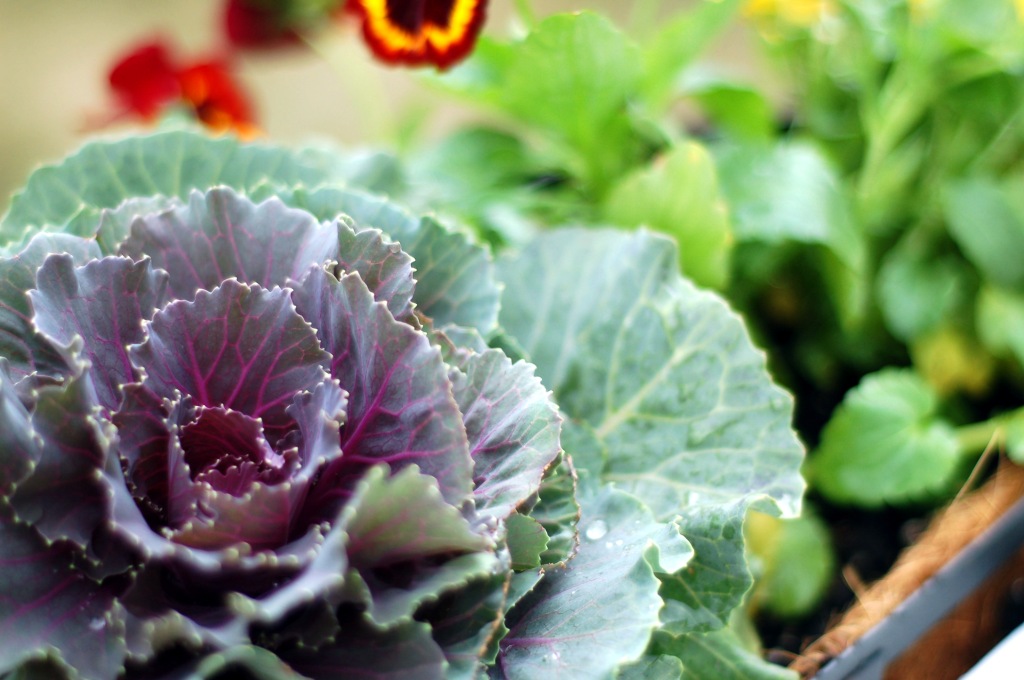
flowering kale cabbage
Pansies and flowering kale
We wanted something alive at our house when winter comes, and the man at the garden shop said pansies and cabbages would be great for garden boxes. The only real gardening I’ve done was in Florida, and I know nothing about winter plants. I am trusting blindly. Even if they don’t last through winter, though, they look awfully pretty now :-).

porch rail garden box
Garden box on the front porch rail

Hahn Horticulture Garden: a Microadventure

My coworker Jeremey DuVall wrote recently about adventuring. Specifically, he wrote about taking more microadventures: little adventures taken at little cost, that take you out of your normal routine, and can be done in your own back yard or your own small town.

I took his advice today. For my birthday, my son gave me a book on butterfly gardening with native plants, and now I’ve been bitten hard by the gardening bug. With a naked lawn — a blank slate — I decided I wanted to go find some ideas. So in the early morning, before the tailgaters were out for the big game tomorrow, I packed a water bottle, my real camera, and a Luna bar; slathered on sunscreen and donned a baseball cap; strapped on my day-pack; and I walked across town, across the Virginia Tech campus, to the University’s horticulture garden.

And boy did I find ideas. Now I want a butterfly garden, an herb garden, a woodland garden, a meadow garden, a waterfall, a pond with lily pads, and much, much more.

I would also like to identify the plant in the images below. Its fragrance drew me across the entire garden, and I want one. If you know what this is, please let me know!

I think my next microadventure might be a trip to the nursery.

Lavender

https://www.flickr.com/photos/funch/5897085846

I grew lavender in Florida. The world is a more beautiful place for the fragrance of lavender.

When we grew herbs in Florida, I would walk out in the garden every morning and run my hands through the lavender plants to release their perfume. In the coolness of dewy mornings it was a lovely fragrance – how to describe scents? Olfaction is the hardest sense to write. Lavender is herby and floral and evergreen, it is soft wood; it is both warm and cool like its flowers’ colors, light and silvery like its leaves.

Other times of day, when I worked in the garden, I’d brush against its fuzzy blue green needles to smell it again: with my forearm while I dug holes, with my shin as I walked by, with my shoulder when I crouched to investigate leaf bottoms, searching for butterfly eggs. By the end of summer, it was sometimes tall enough that I would brush it with my hip and a warm current of lavender fragrance would drift up and make me stop to breathe it in.

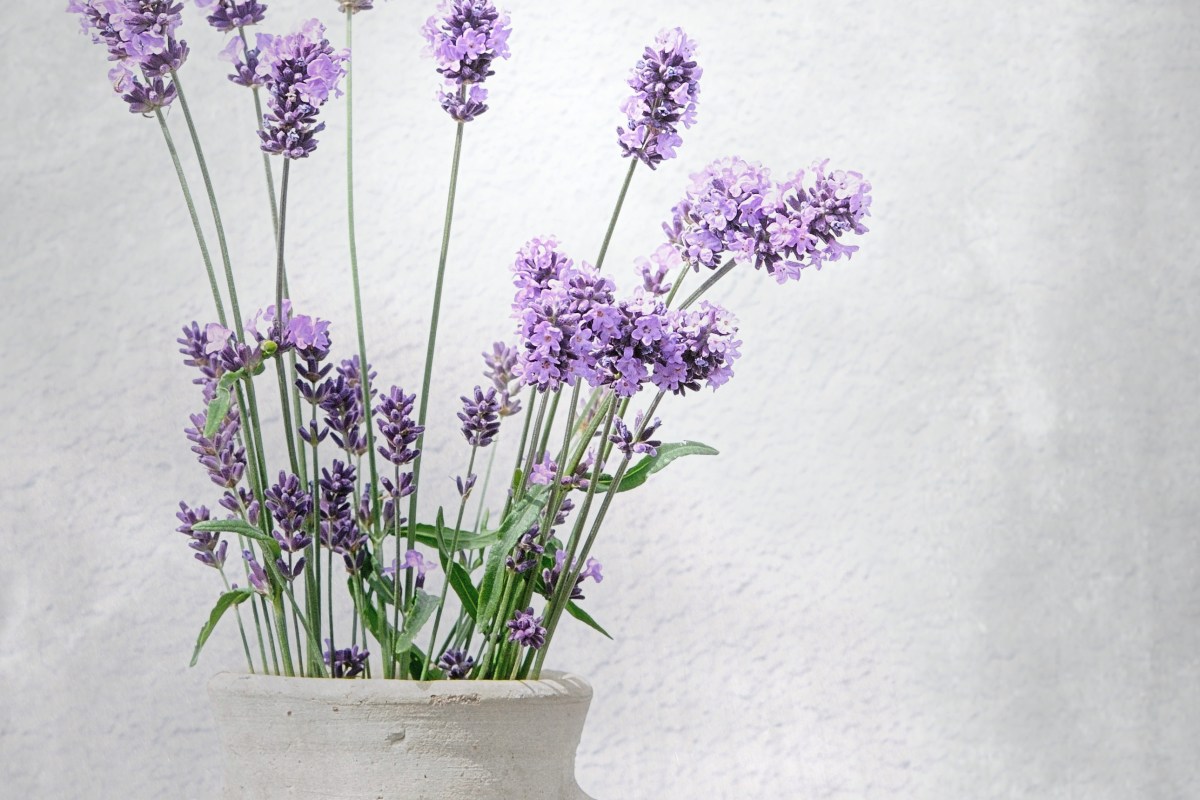
The best part of growing my own, and why I can’t wait to move and start cultivating it again, is that when it is in bloom, and even when it isn’t, we can have bouquets of lavender in our house. I’ll cut sprigs and spears and stems laden with tiny purple flowers, and I’ll fill glass jars with water, and I will place lavender nosegays in every room: on the dining and coffee tables, on the bar, on bright window sills, and best of all, on bedside tables, where we’ll drift to sleep breathing one of the loveliest scents of the earth.

Photo credit: A little arrangement by Lotte Grønkjær

For the month of April, I will be publishing a 10-minute free write each day, initiated by a prompt from my prompt box. Minimal editing. No story. Just thoughts spilling onto the page. Trying to get back into the writing habit.